
But What If You’ve Already Done All of That?
This is where my story gets more complicated.
Because I have separated the finances.
Not partially.
I have taken full control of them because addiction made it necessary.
We’ve done rehab.
We’ve done therapy.
We’ve involved family.
We’ve brought other people into the situation for accountability.
We’ve had the conversations.
We’ve cried.
We’ve prayed.
We’ve made plans.
We’ve talked about consequences.
We’ve had promises made after painful discoveries.
We’ve tried things that were supposed to help.
And still…
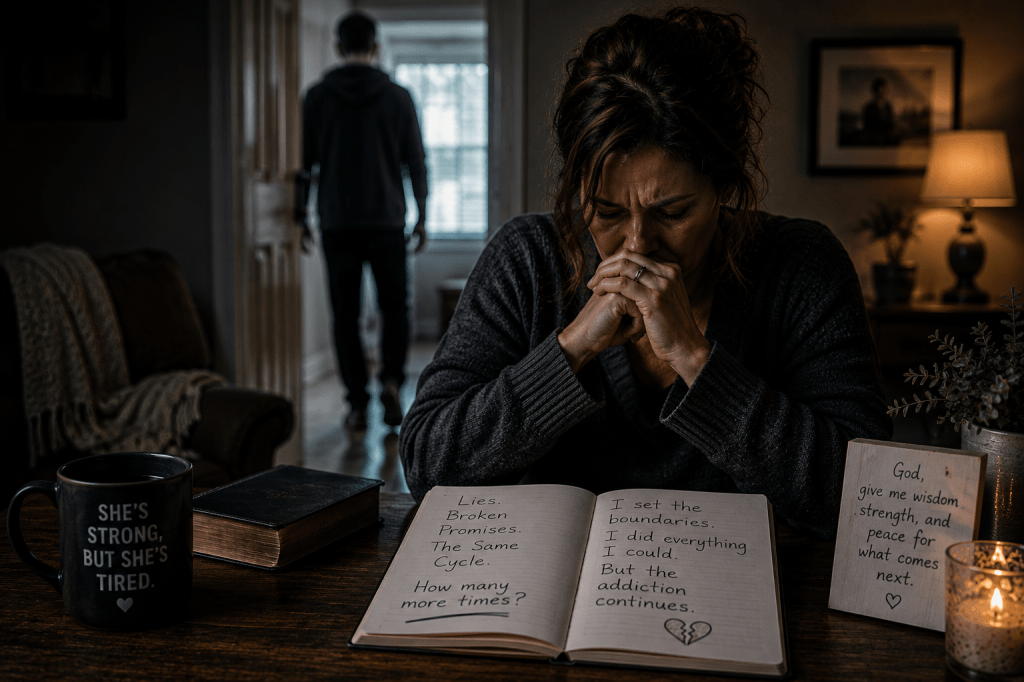
the addiction continues.
The lies continue.
That’s the part I’m struggling to understand now.
Because eventually you run out of smaller boundaries.
There comes a point where you’ve already moved the money. You’ve already created accountability. You’ve already encouraged treatment. You’ve already stopped hiding everything from the people closest to you.
And you’re still standing there looking at the same behavior.
So what boundary comes next?
That question terrifies me.
When You’ve Done Everything Except Leave
Maybe that’s the part I haven’t wanted to say out loud.
What happens when you’ve done almost everything you know to do except physically remove yourself from the cycle?
That’s a much harder question than, “How do I set a boundary?”
Because I know how to set boundaries now.
I know how to protect the finances.
I know how to say no.
I know how to involve other people.
I know how to encourage treatment.
I know how to recognize manipulation much faster than I used to.
What I don’t always know is what to do when none of it changes the person I love.
There is a painful realization that comes with that:
Maybe the purpose of my boundaries was never to make him change.
I think somewhere inside me, I still believed they would.
If I controlled the finances, maybe the gambling would stop.
If enough people knew, maybe the accountability would stop the lying.
If he went to rehab, maybe he would finally understand.
If therapy uncovered the deeper issues, maybe everything would begin to change.
If he saw how close he came to losing his marriage, surely that would be enough.
But what happens when it isn’t?
What happens when every safeguard you put into place becomes another obstacle the addiction learns how to work around?
That is when boundaries stop feeling empowering and start feeling heartbreaking.
Because I am forced to confront something I desperately don’t want to be true:
I can make it harder for addiction to destroy our lives, but I cannot make another person choose recovery.
I Cannot Boundary Someone Into Recovery
That sentence hurts to write.
I cannot boundary someone into recovery.
I cannot monitor someone into honesty.
I cannot control the finances enough to create integrity.
I cannot make accountability work if someone is determined to hide.
I cannot love someone into telling the truth.
I cannot find the perfect therapist, rehabilitation center, consequence, Bible verse, conversation, or arrangement that will make someone choose something they are unwilling to choose for themselves.
And maybe that’s why this stage feels so different.
In the beginning, there was always another thing to try.
Another conversation.
Another boundary.
Another safeguard.
Another treatment.
Another chance.
Doing something made me feel like there was still something I could control.
But eventually you arrive at a place where the question isn’t:
“What else can I do to stop him?”
It becomes:
“What am I going to do if he doesn’t stop?”
And I don’t like that question nearly as much.
Because that question is about me.
The Apology Doesn’t Fix It Anymore
There was a time when an apology brought relief.
Maybe this time he understood.
Maybe this was rock bottom.
Maybe losing this much would finally be enough.
Maybe seeing me this broken would finally make something click.
But after enough cycles, apologies begin to feel different.
You want to believe them.
Part of you still does.
But another part of you is quietly keeping track of everything that came before.
You remember the other apologies.
The other promises.
The other “last times.”
The other moments when you thought the nightmare was finally ending.
So you’re standing there listening to someone say they’re sorry while two completely different voices are fighting inside you.
One says:
Give him grace.
People mess up.
Addiction is hard.
Marriage means fighting for each other.
God can still restore this.
And the other says:
We’ve been here before.
That second voice used to make me feel guilty.
Now I’m beginning to wonder if that voice isn’t bitterness at all.
Maybe it’s discernment.
Maybe wisdom sometimes remembers the pattern even when your heart desperately wants to believe the promise.
When Hope Starts Keeping You Stuck
This is difficult for me to admit because hope sounds like such a beautiful Christian word.
And it is.
I believe in hope.
I believe God changes people.
I believe marriages can be restored.
I believe addicts can recover.
I believe broken things can become beautiful again.
But I’m beginning to understand that hoping someone changes and living as though they already have are two very different things.
I can hope for recovery without pretending recovery is happening.
I can pray for honesty while acknowledging that I’m still being lied to.
I can believe God can restore my marriage without calling the current situation restored.
Maybe faith isn’t denying what is happening because I’m afraid of what acknowledging it might require me to do.
Maybe faith is trusting God enough to tell the truth about what is happening.
This Is Where Avoidance Gets Really Uncomfortable
Because when all the smaller boundaries have already been put into place, there aren’t many comfortable options left.
That’s when my avoidant side wants to bargain.
Maybe give it a little more time.
Maybe this apology is different.
Maybe therapy will eventually click.
Maybe I need to be more understanding.
Maybe I’m expecting too much too quickly.
Maybe I should just be thankful for the good days.
Some of those thoughts may occasionally contain truth.
Recovery isn’t perfect.
People do stumble.
Change takes time.
But there is also a difference between an imperfect recovery and an ongoing pattern of addiction, deception, and manipulation without sustained change.
I have to be careful that compassion doesn’t become the excuse I use to avoid making a decision.
Because eventually, “give it more time” can become years.
The Boundary I’m Afraid Of
Maybe this is where I am learning that the hardest boundary isn’t controlling money.
It isn’t demanding treatment.
It isn’t telling family.
It isn’t even saying, “I won’t tolerate this anymore.”
The hardest boundary may be accepting what I will have to do if nothing changes.
I don’t write that lightly.
I don’t believe marriage should be discarded because things become difficult.
I don’t believe struggling with addiction makes someone unworthy of love.
And I certainly don’t believe every wife reading this should make the same decision.
But I also no longer believe that loving someone requires me to endlessly absorb the consequences of choices I cannot control.
There is a point where I have to stop asking:
“What else can I do to make him change?”
and start asking:
“God, what are You asking me to do if he chooses not to?”
That prayer scares me.
Because I have spent so much time praying for God to change him.
Maybe now I also need the courage to ask God to show me what obedience looks like for me.
Maybe Boundaries Were Never About Saving My Marriage
I wanted boundaries to save my marriage.
I wanted treatment to save it.
I wanted accountability to save it.
I wanted controlling the finances to save it.
I wanted therapy to save it.
I wanted love, patience, forgiveness, prayer, consequences, and second chances to eventually add up to transformation.
But none of those things can substitute for another person’s willingness to change.
Maybe boundaries aren’t how I save my marriage.
Maybe boundaries are how I stop losing myself while I wait to see what the other person chooses.
And maybe that is what I am finally beginning to understand.
I can love him.
I can pray for him.
I can forgive him.
I can hope for him.
I can believe with everything inside me that God is capable of completely transforming his life.
And I can still tell the truth about what is happening right now.
The addiction continues.
The lies continue.
The boundaries haven’t produced the change I hoped they would.
And I cannot keep pretending that an apology is the same thing as recovery.
Maybe the next step isn’t another rule for him.
Maybe it’s finally asking God what He wants from me when I have done everything I know to do—and the person I love still chooses the addiction.
I don’t have a neat answer to that yet.
Maybe that’s okay.
Maybe understanding myself begins with finally being willing to ask the question.

