The Secret Place

Somewhere in the mess… you disappeared.

Between the responsibilities, the heartbreak, the expectations, and the silent battles no one sees—you got lost. Not all at once. But slowly. Quietly. Piece by piece.

And now you look in the mirror and barely recognize her.

Here is the truth no one wants to say out loud:
You will not find yourself in the noise.
You will not heal by staying busy.
You will not rise by pretending you’re fine.

You find yourself in the longing.

That ache deep inside that whispers, There has to be more than this.

We were never called to survive at surface level. Survival keeps you functioning—but it does not make you whole. It keeps you moving—but it does not make you free.

Freedom lives in the secret place.

Not a physical place. A sacred one. The place where only you and the Father have walked. The place you avoid because it feels too deep, too raw, too exposed.

But that is where she is.

The happy, carefree, full-of-life, Jesus-got-this kind of girl. She isn’t gone. She’s buried under fear, disappointment, and exhaustion.

Scripture says,

“He who dwells in the secret place of the Most High shall abide under the shadow of the Almighty.” — Psalm 91:1

Dwelling requires staying.
Staying requires courage.

It takes courage to sit still long enough to feel what you’ve been outrunning.
Courage to face the darkest parts of your own heart.
Courage to stop surviving and start seeking.

But healing does not happen on the surface.

It happens in the depths—the place where the tears fall freely and the masks come off. The place where you finally whisper the prayers you’ve been afraid to pray.

And there, in that quiet, the Father meets you.

Not with shame.
Not with disappointment.
But with presence.

Until you choose to rise and visit the hidden places of your soul, you will never rise from the ashes of the life you are living.

It is okay to feel.
It is okay to stop.
It is okay to take time for you.
To be quiet.
To be still.
To search.
To seek.
To pray.

Push yourself toward what makes you healthy. Safe. Stable. Whole.

Turn down the noise.
Shut the door.
Go to the secret place.

And stay.

Because when you do, the pieces begin to settle. The lies lose their grip. The chaos grows quiet.

And one day you will look in the mirror again—

And recognize her.

Not the woman who barely survived.
But the one who went into the depths…
and came back alive.

Open Wounds

There are wounds you can see.
And then there are the ones that bleed quietly beneath the surface.

Emotional neglect creates wounds that do not bruise the skin but fracture the spirit. When instability becomes your normal — when love feels conditional, when affirmation is rare, when your value is questioned more than it is celebrated — you begin to question yourself. Your worth. Your character. Your place.

You replay conversations.
You analyze your tone.
You shrink to make things easier.

And still, it is not enough.

Healing in that environment feels like a revolving door. Just when you think the wound is closing, another careless word, another dismissive glance, another broken promise tears it open again. Open wounds make you lose yourself in the mess of your circumstances. They keep you focused on survival instead of restoration. They convince you that endurance is the same thing as healing.

But it is not.

There must come a moment — quiet but firm — when you realize that tending to your own soul is not selfish. It is necessary. There must come a time when you decide to put yourself first, to cut off the chains that have kept you bound to confusion, to chaos, to constant questioning. A season of healing will ask things of you. It may require letting go. It may mean surrendering what you hoped would change. It may even mean walking away from the ones you love most.

That is not weakness.
That is courage.

Healing is not loud. It is not dramatic. It is often unseen. It is choosing peace when dysfunction calls your name. It is choosing truth when lies have defined you. It is choosing to believe that God did not design you to live in perpetual wounding.

Scripture reminds us:

“He heals the brokenhearted and binds up their wounds.” — Psalm 147:3

Notice — He binds up their wounds. He does not shame them for having them. He does not rush them through the process. He does not dismiss the depth of the pain. He draws near and tends to what is open.

The journey of healing is one only you can walk — but you do not walk it alone. Your Maker is not intimidated by your trauma. He is not exhausted by your tears. He is not confused by your questions. Where people were inconsistent, He is steady. Where love was withdrawn, His remains.

Do not lose hope over the open wounds.

They are not proof that you are unworthy.
They are proof that something hurt you.

And what hurt you does not get to define you.

Choose life.
Choose healing.
Choose the slow, sacred process of becoming whole again.

The wound may be open today.
But it does not have to stay that way.

Her Silence

Silence isn’t harsh.

It isn’t cold.
It isn’t punishment.
It isn’t manipulation.

It is exhaustion.
It is grief.
It is quiet defeat after fighting battles no one else saw.

When her voice has been dismissed long enough…
When her emotions have been minimized…
When her needs have gone unmet…

Silence does not arrive loudly.

It creeps in.

Slowly.

She does not wake up one morning deciding to withdraw. She arrives there after trying. After explaining. After crying. After praying. After hoping.

And when nothing shifts… something inside of her does.

Silence becomes protection.

Not because she wants distance — but because she can no longer survive exposure.

Survivor mode is never a place she longs to be.

No woman dreams of becoming guarded. No wife desires to grow quiet. No heart hopes to become cautious with the very person it once felt safest with.

And yet, survivor mode often finds her.

It finds her when she realizes she must fight not just for the marriage — but for herself.

There is a particular kind of desperation in silence. It is the moment she realizes that if she does not guard her heart, she may lose herself entirely in the longing for what used to be.

But here is the sacred turning point:

If she finds the strength and courage not to disappear inside the silence… she will discover something unexpected there.

She will find herself.

Not the version shaped by disappointment.
Not the version shrinking to be understood.
Not the version constantly over-explaining her pain.

But a woman rebuilding.

A woman expecting.

Expecting growth in the quiet.
Expecting clarity in the stillness.
Expecting healing in the hidden places.
Expecting peace that does not depend on another person’s consistency.

There is hope in her silence.

Because silence is not the end — it is the reset.

Psalm 46:10 says,
“Be still, and know that I am God.”

Be still.

Not because the pain isn’t real.
Not because the marriage doesn’t matter.
Not because the hurt disappears.

But because in the stillness, God begins to restore what chaos tried to steal.

In the silence, He reminds her:

She is not invisible.
She is not irrational.
She is not too much.
She is not alone.

He meets her there — not in the shouting, not in the proving, not in the defending — but in the quiet surrender.

And slowly, what once felt like defeat becomes rebuilding.

She finds peace in the silence.
Growth in the silence.
Joy in the silence.
Hope in the silence.
Laughter in the silence.
A new breath of life in the silence.

The silence that once felt like loss becomes the place she rediscovers her strength.

And when she rises again, she will not rise hardened.

She will rise healed.

And that kind of woman?
She no longer fights to be heard.

She walks in peace — knowing the One who sees her never stopped listening.

The Dirty Window

Oftentimes I sit at the large kitchen island, directly across from a dirty window.

I sit there with great intention — determined to put my thoughts on paper. But more often than not, I find myself just staring… gazing for what feels like an eternity through that dirty window.

And as I sit here again, staring through the smudged glass, I begin to wonder why I have never mustered up enough motivation to clean it.

In an awkward, almost confusing way, I have come to realize something:

I find comfort in the dirty window.

As strange as that sounds, I’ve caught myself rationalizing it more than once. The dirty window has become a quiet form of consistency. And if I am honest, consistency is something my heart longs for more often than I would like to admit.

The window is imperfect — yet unchanging.
The beautiful view beyond it is clouded by spatter and streaks.
The mess blurs what could otherwise be clear.

And yet… it remains the same.

Then it hits me.

Life is the dirty window.

Each day brings its own spatter. Its own streaks. Its own unexpected splashes of chaos that we often have no idea how to cleanse. The more we try to wipe it away, sometimes the more smeared and cloudy it becomes.

We try to fix the mess.
We try to restore clarity.
We try to regain control.

But life lacks the consistency we crave.

Every new day holds unknown variables.
Unexpected conversations.
Unplanned disappointments.
Unforeseen struggles.

And that lack of consistency can create an environment that feels unsteady. Unstable. Unpredictable.

Yet at the end of the day, when I sit back down at the island and gaze through that same dirty window, there is something oddly comforting about its unchanged imperfection.

The mess is still there.
The smudges haven’t moved.
The view is still blurred.

And somehow, that consistency in the imperfection steadies me.

But here is what the Lord has been gently whispering to my heart:

While the window may remain dirty… He does not.

Our days may feel inconsistent.
Our emotions may fluctuate.
Our circumstances may cloud our vision.

But God is not unstable.

“The Lord is my refuge and my fortress, my God, in whom I trust.” — Psalm 91:2

Refuge.
Fortress.
Not shifting.
Not unpredictable.
Not clouded.

When life spatters our windows and blurs our view, it is easy to grow accustomed to the mess. We learn to live with the streaks. We adapt to the distortion. Sometimes we even mistake the familiar chaos for comfort.

But our true consistency is not found in the unchanging mess.

It is found in an unchanging God.

Hebrews 13:8 reminds us:

“Jesus Christ is the same yesterday and today and forever.”

Yesterday — when the window first got dirty.
Today — as we stare through it.
Forever — long after the smudges are gone.

Life may feel inconsistent.
Our emotions may feel unstable.
Our clarity may feel clouded.

But God remains steady in the middle of our scattered days.

And maybe — just maybe — the dirty window isn’t there to comfort me.

Maybe it is there to remind me that even when my view is blurred, my foundation is not.

Even in the mess.
Even in the unknown.
Even in the inconsistent chaos of each day.

He is steady.

And that is enough.

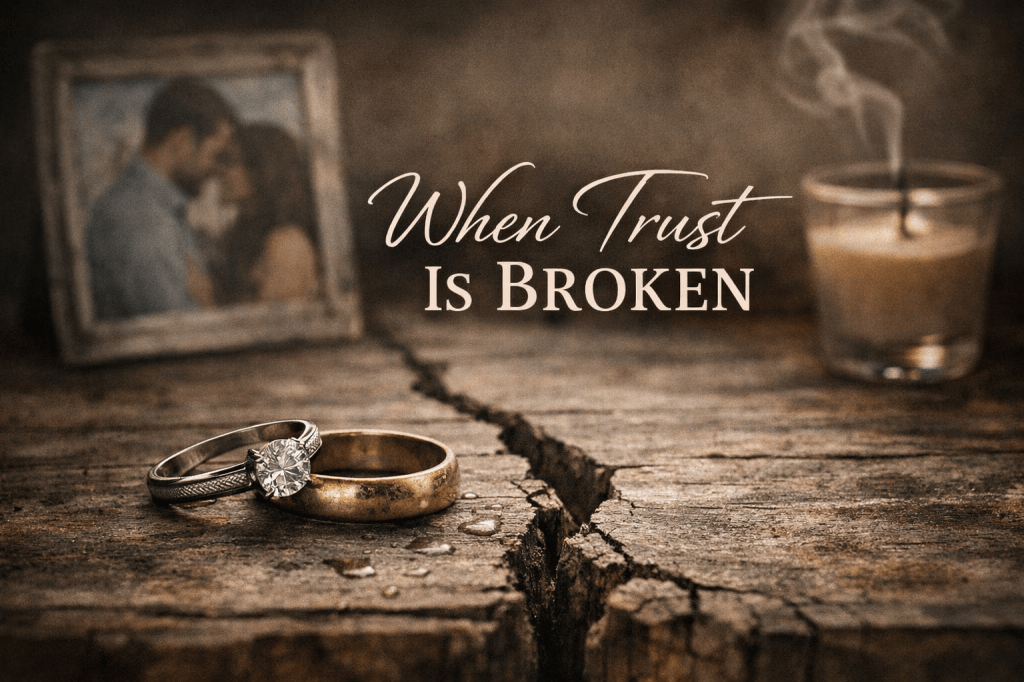
When Trust is Broken

Trust isn’t something we give freely.
It is earned slowly, layered carefully, and protected fiercely.

And once it’s stolen… it can feel almost impossible to give back.

I often find myself wondering what a relationship even is once trust is no longer a factor. If trust is the foundation, what remains when the foundation cracks?

The framework may still be standing.
The title may still exist.
The vows may still echo in memory.

But something essential has shifted.

The foundation of any healthy relationship should be built on trust and honesty. When we begin to trust someone, conversations deepen. Emotional connection begins to form. Safety is established. A friendship grows. And in that space, love flourishes.

Especially in marriage.

The love between a husband and wife is not casual — it is covenant. It is sacred. It is “till death do you part.” It is two becoming one, vulnerable and exposed without fear of harm.

But what happens when that covenant is fractured?

When lies replace truth.
When deception clouds clarity.
When manipulation distorts reality.
When addiction takes precedence over intimacy.
When dishonesty becomes a pattern instead of a mistake.

It takes you to an unrecognizable place.

A place where you question your discernment.
Where you replay conversations.
Where peace feels foreign.
Where dissatisfaction quietly begins to manifest in your soul.

It is not just disappointment.
It is disorientation.

Because trust is not simply about behavior — it is about safety. And when safety is compromised, the heart goes into survival mode.

You begin guarding instead of giving.
Withholding instead of welcoming.
Protecting instead of partnering.

And somewhere in the midst of that, you grieve.

You grieve the marriage you thought you had.
You grieve the version of the person you believed in.
You grieve the simplicity that once existed.

Broken trust does not just damage connection — it wounds identity. It makes you question what was real and what was performance.

But here is what I am learning in the quiet:

Even when human trust is broken, God remains faithful.

Where people fail, He does not.
Where deception lives, He is truth.
Where manipulation confuses, He brings clarity.
Where dishonesty destabilizes, He stands firm.

Trust may feel impossible to rebuild in the natural — but it was never meant to rest solely on human strength.

Psalm 118:8 says:

“It is better to take refuge in the Lord than to trust in humans.”

That verse used to feel harsh to me. But now it feels protective.

God never intended for another human to be the sole keeper of our security. Marriage is covenant, yes — but ultimate trust belongs to the Lord.

When earthly trust is fractured, it drives us back to the One who cannot lie, cannot manipulate, cannot abandon, cannot betray.

“The Lord is faithful to all His promises and loving toward all He has made.” — Psalm 145:13

Faithful to all His promises.

Not most.
Not sometimes.
All.

Trust may take time to rebuild. Healing may require boundaries. Restoration may demand truth, repentance, and accountability.

But even if the relationship feels unrecognizable right now — you are not without foundation.

If everything else feels unstable, anchor yourself here:

God is trustworthy.

And when you build your peace on Him first, you will never be standing on shifting ground again.

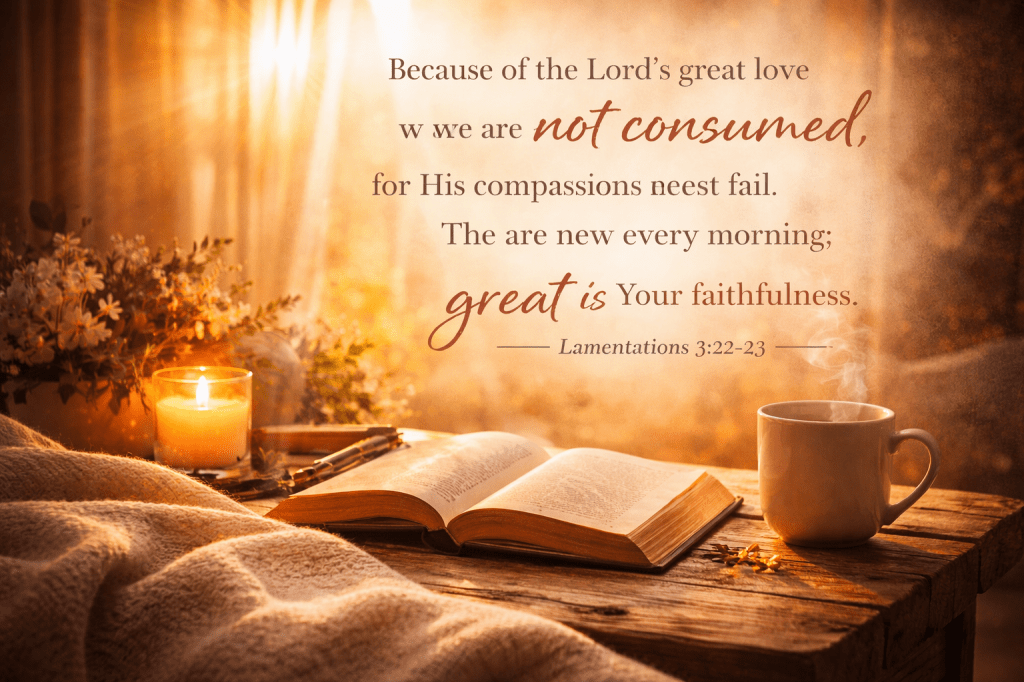
Not Consumed

“Because of the Lord’s great love we are not consumed, for His compassions never fail. They are new every morning; great is Your faithfulness.” — Lamentations 3:22–23

There is a sacred weight that comes with truly loving and serving the Lord.

When you devote yourself to the Church.
When you pour into ministry.
When you show up for people again and again.
When you carry burdens no one else sees.

You strive to serve Him well. You want to be faithful. You want to honor God with your life.

And yet… life can still feel heavy.

Ministry can exhaust you.
Family responsibilities can stretch you thin.
Spiritual battles can drain your strength.
Unanswered prayers can test your endurance.

Sometimes the very ones who serve the most are tempted to be consumed by discouragement.

Jeremiah wrote Lamentations in the middle of devastation. Everything looked ruined. Yet in the center of grief, he declared:

“We are not consumed.”

Not because the chaos stopped.
Not because the future looked promising.
Not because he had answers.

But because of who God is.

The enemy would love to consume you with:

  • Distraction
  • Comparison
  • Offense
  • Fatigue
  • Anxiety about what’s next

He cannot steal your salvation — but he will try to steal your focus.

And here is the truth:
You will be consumed by something.

If we leave our hearts unguarded, the noise of the day will fill the empty spaces.

But Scripture calls us to something different.

Instead of being consumed by chaos, we must consume ourselves with His presence.

Fill the empty spaces with:

  • Worship music playing in your home and car
  • Quiet moments of prayer, even whispered prayers between tasks
  • Reading Scripture before reaching for your phone
  • Sitting still long enough to let His peace settle your spirit

When you fill your atmosphere with His presence, there is no room for bitterness to take root.
When you saturate your mind with His Word, fear has no place to grow.
When you practice worship in the middle of heaviness, discouragement begins to lose its grip.

His mercies are new every morning — but we must step into them.

Faithfulness is not striving harder.
It is surrendering deeper.

It is waking up and saying:

“Lord, this day is Yours.
This ministry is Yours.
These struggles are Yours.
Lead me through what I cannot see.”

We fight the good fight not by controlling outcomes, but by guarding our focus.

When life feels overwhelming, don’t allow the silence to be filled with the enemy’s whispers.
Intentionally fill it with worship.
Fill it with Scripture.
Fill it with prayer.

Because what fills you will shape you.

And when His presence fills you, the distractions that try to consume you simply have no room.

You may still walk through heavy seasons.
You may not yet see the light at the end of the tunnel.
But you will not be consumed.

Not because you are strong —
But because He is faithful.

Great is His faithfulness.
New mercy is waiting for you tomorrow morning.

And when you choose to fill yourself with Him, you will have strength to keep fighting the good fight — steady, surrendered, and unconsumed.

Loneliness

Loneliness is not something we choose. It is not something we crave. It is a dark and tender place we sometimes find ourselves in at the most unexpected moments of life. A place that feels cold. Heavy. Quiet in ways that echo too loudly.

It can feel impossible to carry the burdens we bear when there is no one beside us to help hold them.

In those moments, what we long for is simple—conversation. Connection. The kind of emotional safety that allows us to exhale. The kind of bonding that lets us be fully ourselves without fear of judgment. There is something sacred about genuine conversation. It reaches into the deepest parts of our loneliness. It reminds us we are seen. It can bring light to the worst of days and lift our spirits just enough to keep going.

Sometimes it’s the smallest things—a shared laugh, a thoughtful message, a few minutes of feeling understood. Little bursts of sunshine. Brief reminders that we are alive and that someone notices.

But when that connection fades… when the conversation stops… when what felt like your last lifeline slips away, the grief can take you by surprise.

You find yourself staring into the stillness of the day. Sitting in the car longer than necessary, gathering the strength to step back into normal life. Lying awake at night, alone with thoughts that replay what once was. And in those quiet hours, you feel grief—not only for the person or connection you lost, but for who you were in that season… and for what you hoped it might become.

It is grief for what was.
Grief for what could have been.
Grief for the version of you that felt less alone.

And yet, even there—in the quiet car, in the sleepless night, in the ache you can’t quite name—Scripture whispers something steady and true:

“The Lord is close to the brokenhearted and saves those who are crushed in spirit.” — Psalm 34:18

Close. Not distant.
Near. Not absent.

When loneliness convinces you that you are unseen, God draws nearer still. When your spirit feels crushed under the weight of loss, He does not turn away from your grief—He moves toward it.

And in those desperate, fragile moments, a question rises in the silence:

How far are you willing to go for connection?
How much of yourself are you willing to trade just to not feel alone?

Loneliness can tempt us to reach for anything that promises relief. But not every connection is healthy. Not every conversation is safe. Not every lifeline leads to life.

Sometimes the bravest thing we can do in our loneliness is pause. To remember that our longing for connection was placed in us by God—not to drive us toward desperation, but toward healthy, life-giving relationships. Toward Him first. Toward people who reflect His heart.

You are not weak for feeling lonely.
You are human.

And even in the quiet, unseen places, you are not abandoned. He is close.

Boundaries

Every wife must set boundaries.

PTSD introduces unique and heavy challenges into a marriage—challenges that can leave a woman feeling alone, neglected, unheard, unseen, unappreciated, and, at times, deeply unloved. But at no point should this become your new normal. Nor should it be allowed to define your marriage or your identity.

Scripture is clear about God’s design for marriage. Ephesians 5 paints a picture of love that is sacrificial, honoring, and protective—a love in which a husband is called to love his wife as Christ loves the Church. PTSD does not exempt a marriage from God’s design, nor does it excuse behavior that wounds, diminishes, or devalues.

Your worth is not determined by your spouse’s capacity or condition. Your worth comes from the Father. When the weight feels unbearable, you must press into Him—seeking His will, His strength, and His truth—to walk this journey and fight these battles with wisdom and courage.

Boundaries are not punishment. They are protection. They define what is acceptable and what is not. And when boundaries are crossed, action must follow. Accountability is necessary. Consistency matters. Boundaries that are not enforced eventually become suggestions.

If we are willing to draw permanent boundary lines against the enemy to keep him out of our homes and hearts, why would we not do the same within our marriages to guard against what seeks to steal, kill, and destroy?

Set boundaries. Keep them. Let them define you—not fear, not guilt, not someone else’s brokenness.

“Above all else, guard your heart, for everything you do flows from it.” — Proverbs 4:23

The Friend in My Pocket

Oftentimes, I find myself in a place of confusion. A place where my own words echo in an empty room, never to be heard. A place where conversation feels as though it never truly existed. A place where companionship, touch, intimacy—and simply living—have quietly vanished.

It takes me back to when I was a small child with an imaginary friend who somehow satisfied the loneliness in my mind. Every thought, every emotion, every moment of every day was spent knowing that if I just said their name, I would suddenly be in the presence of company again.

It sounds silly as an adult, but children possess an imagination that gently carries them through the roughest seasons of life—simply by creating an image, giving it a name, a home, and calling it a very best friend.

Somewhere along the years, I lost my imaginary friend. And in moments like these, I find myself longing to be a child again.

To have a friend in my pocket—to bring joy to my sorrow, ease to my pain, a bit of laughter when the days feel too heavy—feels like a gift I deeply miss. Most of all, I long for the comfort of an unbiased conversation, one that asks nothing and judges nothing.

A simple smile to help me conquer the hardest days. And the greatest comfort of all would be knowing I had a friend in my pocket—one who would never leave my side.

Maybe growing up isn’t about losing imaginary friends—maybe it’s about learning how deeply we still need one.

Boundaries

Boundaries are the invisible lines we place in our relationships to protect our character, guard our hearts, preserve self-respect, and uphold our dignity. They are not walls meant to shut people out, but safeguards that keep us whole.

But what happens when those boundaries begin to blur for the sake of a partner?

Too often, we overgive, overlove, and overextend ourselves until there is nothing left. We pour from an empty cup, believing sacrifice equals love, while slowly losing pieces of who we are. Boundaries were never meant to create conflict or push people away—they are necessary to allow us to be the healthiest version of ourselves without being taken for granted, walked over, mistreated, or devalued simply because our limits make someone uncomfortable.

When hate, rudeness, selfishness, sinful habits, or addiction begin to erode those boundaries, love does not mean silence. Love means pushing back—with truth, grace, and firmness—and enforcing what protects both your heart and your calling.

When boundaries are abandoned in marriage, the result is not unity but division. Not intimacy, but dependency. Not peace, but exhaustion. And over time, the slow erosion of boundaries often leads to the complete loss of what once was.

Healthy boundaries don’t destroy relationships—they reveal whether a relationship is healthy enough to survive. And sometimes, the most loving thing you can do is refuse to lose yourself in the process of loving someone else.

“Above all else, guard your heart, for everything you do flows from it.”
Proverbs 4:23

Boundaries are not a lack of love—they are wisdom in action. Guarding your heart honors the life God has entrusted to you and preserves the love He intends to flow through you. When boundaries are upheld with truth and grace, they become an act of obedience, not rejection—an invitation to walk in health, wholeness, and lasting love.