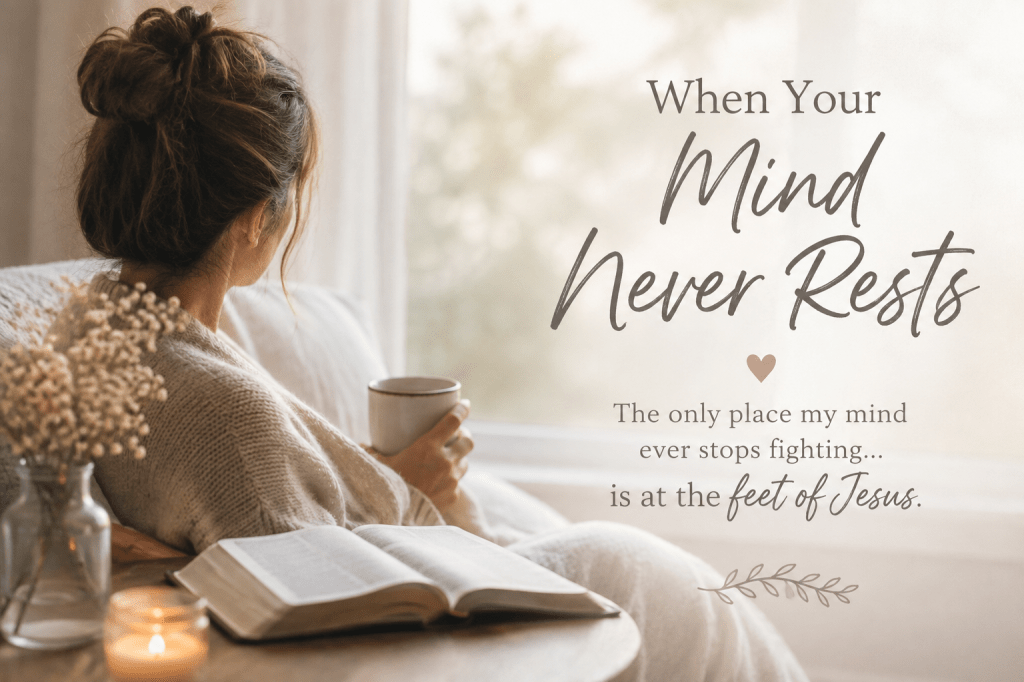
When Your Mind Never Rests

I used to think rest meant getting more sleep.

Taking a day off.

Watching a movie.

Going on vacation.

Sitting quietly with a cup of coffee.

But I’ve learned there is a kind of exhaustion that sleep can’t touch.

It’s the exhaustion that comes from never allowing your mind to fully let go.

If you’re married to someone battling PTSD and addiction, you probably know exactly what I’m talking about.

Your body may be sitting on the couch, but your mind is somewhere else.

It’s wondering if what you’re being told is the whole truth.

It’s replaying yesterday’s conversation, trying to figure out if you missed something.

It’s noticing little changes in behavior that no one else would ever see.

It’s preparing for the next disappointment before this one has even had time to heal.

You don’t even realize you’re doing it anymore.

It has simply become the way you survive.

I don’t think people understand how loud it is inside our minds.

On the outside, we smile.

We go to work.

We cook dinner.

We laugh with our children.

We sit beside our husbands at church.

We answer, “I’m good,” when someone asks how we’re doing.

But inside… our minds never stop searching for solid ground.

I can’t remember the last time I completely relaxed.

Not because I don’t want to.

Because I don’t know how.

When your heart has been blindsided enough times, it begins to believe that if it stays alert, maybe it can prevent the next heartbreak.

So we stay busy.

We keep cleaning.

We keep organizing.

We keep serving everyone around us.

We keep thinking.

Constantly thinking.

Because slowing down means feeling.

And feeling means touching the grief we’ve spent so much energy trying to hold together.

What I’ve realized is that I haven’t just been carrying my own pain.

I’ve been carrying his too.

His PTSD.

His addiction.

His shame.

His recovery.

His choices.

His consequences.

As if somehow, if I could carry enough of it, maybe he wouldn’t have to.

Maybe then he’d finally have enough strength to get better.

But somewhere along the way, I quietly became exhausted from carrying a burden that was never mine to carry.

Maybe you have too.

Maybe that’s why you’re so tired.

Not because you’re weak.

Not because you’re doing life wrong.

But because you’ve been trying to hold together things that only God can hold.

I wish I could tell you I’ve learned how to quiet my mind.

I haven’t.

There are still nights when my thoughts race faster than I can pray.

There are still days when one unanswered question steals my peace.

There are still moments when I catch myself looking for evidence that everything is okay instead of simply living.

But I’ve discovered something beautiful.

The only place my mind ever stops fighting… is at the feet of Jesus.

Not because my circumstances suddenly change.

Not because the addiction disappears.

Not because tomorrow suddenly feels certain.

But because His presence reminds me that I was never asked to carry tomorrow.

I was only asked to trust Him with today.

There are moments when I open my Bible with tears already filling my eyes, and before I even finish reading, I can almost feel my soul exhale.

For just a moment, the fear grows quieter.

The “what ifs” loosen their grip.

The constant pressure to figure everything out fades into the background.

Nothing around me has changed.

But something inside me has.

Not because I became stronger.

Because I remembered who was carrying me.

Maybe that’s what our souls have been searching for all along.

Not another answer.

Not another promise from the person we love.

Not another guarantee that everything will finally be okay.

Maybe we’ve simply been longing for a place where our weary hearts can finally set the weight down.

Jesus knew there would be people like us.

People who would become weary from carrying burdens they were never meant to carry alone.

That is why His invitation still reaches into my heart every single time I read it:

“Come unto me, all ye that labour and are heavy laden, and I will give you rest.” — Matthew 11:28

Lately, when the noise in my mind becomes too loud, I’ve found myself playing “Quiet (Stripped)” by Maverick City Music.

There is something about those simple lyrics that reminds me of what my heart has been longing for all along—not answers, not certainty, just the quiet peace that only God’s presence can bring.

Maybe that’s why I keep coming back to Jesus.

Not because everything is okay.

But because when my mind refuses to rest, He gently reminds my soul that it can.

If your heart is weary today, I pray you’ll find a quiet place, open His Word, press play, and simply sit with Him for a while.

You don’t have to carry it all today.

Just come.
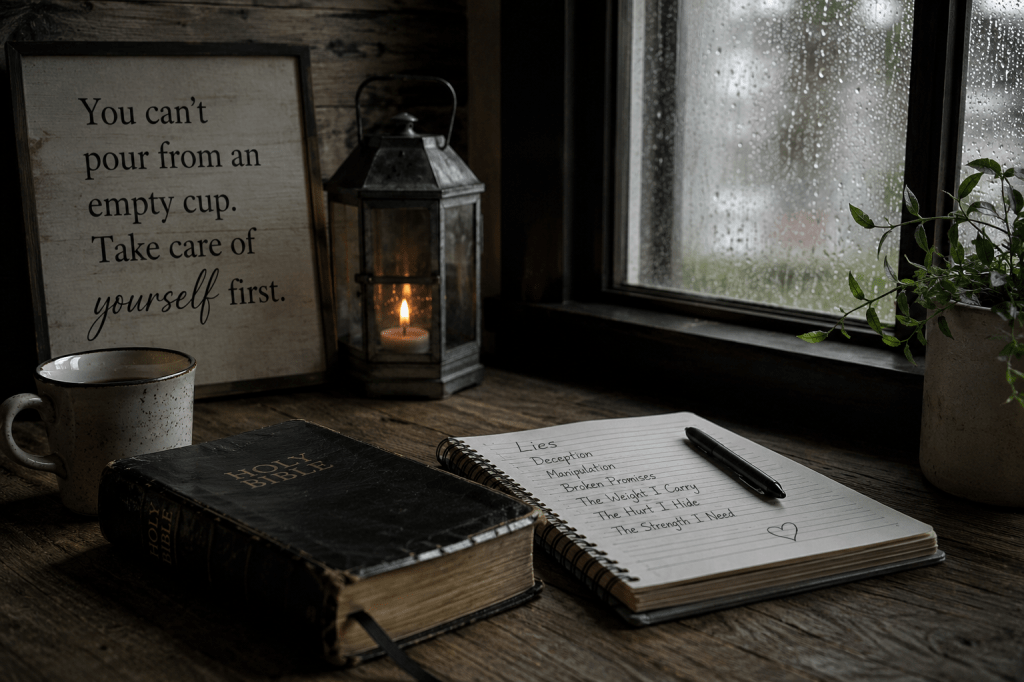
How Can You Love Me and Still Keep Hurting Me?

This is the part that makes addiction so confusing.

My marriage is not bad all the time.

In many ways, it is good.

We laugh.

We enjoy each other.

We can be close.

We can still be intimate.

There are moments when I look at my husband and feel the connection that made me fall in love with him in the first place.

And then there is the addiction.

It sits in the middle of everything good like a weight no one else can see.

Because while the marriage may look normal, and sometimes even feel normal, I am often carrying things quietly underneath it.

The lies.

The deception.

The manipulation.

The broken promises.

The questions I don’t always ask because I already know where the conversation may go.

The hurt I swallow because I don’t want to ruin a good day.

The things I pretend don’t bother me because I want my family to feel okay.

That is the strange part of loving someone with severe PTSD and addiction.

You can genuinely love each other and still be living with something that is slowly destroying trust.

I Don’t Think He Wants to Hurt Me

I truly don’t believe he wakes up wanting to hurt me.

I believe he loves me.

I believe he loves our family.

I believe there are moments when he is deeply sorry for the pain he has caused.

That is what makes it so difficult to understand.

Because if he loves us, why does the addiction keep winning?

Why do the lies continue?

Why does he hide things he knows will eventually be discovered?

Why does he manipulate the truth when he knows what deception has already done to me?

I think addiction has a way of shrinking a person’s world.

For someone carrying severe PTSD, escape can begin to feel like survival.

The mind becomes focused on relief.

Relief from the anxiety.

Relief from the memories.

Relief from the shame.

Relief from whatever is happening inside.

And in that moment, the addiction can become louder than the consequences.

Louder than the marriage.

Louder than the promise.

Louder than the pain waiting on the other side.

That doesn’t mean the family doesn’t matter.

It means addiction can distort priorities so badly that the person stops seeing the full destruction taking place around them.

Then the Lie Protects the Addiction

Sometimes I think the lie becomes just as important as the addiction itself.

Because telling the truth means facing consequences.

It means looking at the person you love and admitting you did the very thing you promised you wouldn’t do.

It means facing disappointment.

It means shame.

It means accountability.

So instead, the truth gets softened.

Pieces get left out.

Things get denied.

The story changes.

And suddenly I am questioning myself again.

Sometimes the hardest part isn’t even what happened.

It’s knowing I may not be getting the whole truth.

That does something to a wife.

You begin listening differently.

Watching differently.

Paying attention to tiny changes.

Wondering if something is off.

And then feeling guilty because you don’t want to become suspicious of the person you love.

I Carry More Than He Realizes

I don’t think he fully understands what I carry.

I carry the knowledge of what has happened before.

I carry the fear that it could happen again.

I carry the financial consequences.

I carry the responsibility of protecting things from falling apart.

I carry conversations in my head that I never say out loud.

I carry the hurt from things I’ve forgiven but haven’t forgotten.

And sometimes I carry all of that while sitting beside him on the couch, laughing at something on television.

That is the part people don’t see.

You can love someone.

You can have a good day.

You can be affectionate.

You can still share a bed.

You can have moments where everything feels almost completely normal.

And still have a part of you quietly hurting underneath it all.

Sometimes I think wives become very good at holding both realities at the same time.

I love him.

And:

This is hurting me.

Both are true.

Understanding Isn’t the Same as Excusing

I have spent a lot of time trying to understand PTSD and addiction.

And understanding has helped me have compassion.

But I am learning that compassion can become dangerous when I use it to explain away everything that hurts me.

PTSD may explain why he wants to escape.

Addiction may explain why his thinking becomes distorted.

Shame may explain why telling the truth is difficult.

But none of those things make deception harmless.

They don’t erase the damage.

They don’t make manipulation okay.

And they don’t magically rebuild trust.

I can understand why something happens and still say:

This is not okay.

That has been a difficult lesson for me.

Maybe He Doesn’t See the Weight Because I’m Carrying It So Well

Sometimes I wonder if part of the reason he doesn’t fully see the impact is because I have become so good at carrying it.

I keep going.

I keep working.

I keep the family functioning.

I take care of what needs to be taken care of.

I forgive.

I pray.

I smile.

I show up.

I tell people we’re okay.

And maybe from the outside, we are.

But there are parts of me that are exhausted from carrying things quietly.

Maybe I have protected everyone from seeing the weight for so long that I sometimes forget I am allowed to admit that it is heavy.

Love Doesn’t Cancel the Damage

This is what I am beginning to understand.

A person can love you and still hurt you deeply.

A marriage can have beautiful moments and still contain something destructive.

You can be emotionally and physically close to someone and still feel lonely in the places where trust has been broken.

Those realities do not cancel each other out.

I don’t have to convince myself the entire marriage is bad in order to admit that addiction is harming it.

And I don’t have to deny the good in order to tell the truth about the pain.

I can say:

My husband loves me.

Our marriage has good in it.

We still have closeness.

And also:

The addiction continues to wound me.

The lies have changed me.

The manipulation has made me question myself.

And carrying all of it quietly is exhausting.

Maybe that is the truth I need to stop hiding from myself.

Because pretending I am okay does not make me okay.

And protecting everyone else from the truth does not make the truth disappear.

I still believe God can heal addiction.

I still believe people can recover.

I still believe marriages can be restored.

But I am learning that hope does not require pretending.

I can hope for change while acknowledging the weight I am carrying right now.

And maybe healing for me begins when I stop telling myself that because there is still love, I shouldn’t be hurting.

There is still love.
And I am still hurting.
Both can be true.

And maybe on the days when carrying both feels too heavy, I need to remember that none of it is hidden from God.

“Thou tellest my wanderings: put thou my tears into thy bottle: are they not in thy book?” — Psalm 56:8

There is something comforting about knowing that even when no one else fully sees the weight I am carrying, God does.

He sees the tears I wipe away before anyone notices.

He sees the conversations I replay in my mind.

He sees the hurt behind the smile.

He sees the love I still have for my husband and the pain that exists right beside it.

Nothing about my grief is hidden from Him.

Maybe that is where I need to rest when I am tired of pretending I am okay.

There is still love.
And I am still hurting.
Both can be true.
And God sees them both.

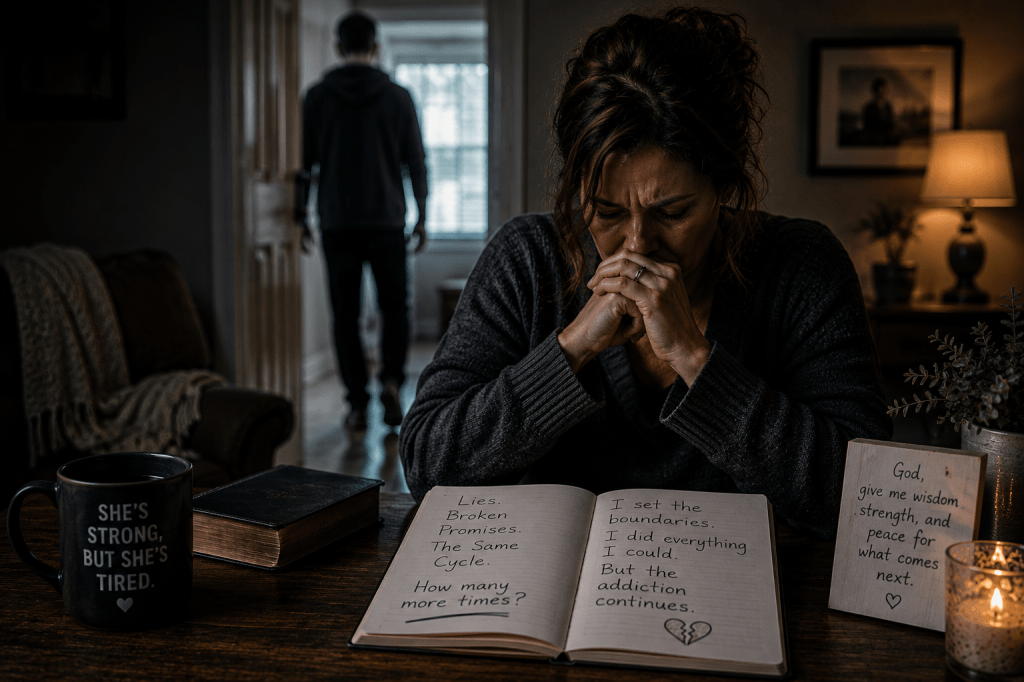
When Boundaries Aren’t Enough: Loving an Addict Who Keeps Crossing Them

But What If You’ve Already Done All of That?

This is where my story gets more complicated.

Because I have separated the finances.

Not partially.

I have taken full control of them because addiction made it necessary.

We’ve done rehab.

We’ve done therapy.

We’ve involved family.

We’ve brought other people into the situation for accountability.

We’ve had the conversations.

We’ve cried.

We’ve prayed.

We’ve made plans.

We’ve talked about consequences.

We’ve had promises made after painful discoveries.

We’ve tried things that were supposed to help.

And still…

the addiction continues.

The lies continue.

That’s the part I’m struggling to understand now.

Because eventually you run out of smaller boundaries.

There comes a point where you’ve already moved the money. You’ve already created accountability. You’ve already encouraged treatment. You’ve already stopped hiding everything from the people closest to you.

And you’re still standing there looking at the same behavior.

So what boundary comes next?

That question terrifies me.

When You’ve Done Everything Except Leave

Maybe that’s the part I haven’t wanted to say out loud.

What happens when you’ve done almost everything you know to do except physically remove yourself from the cycle?

That’s a much harder question than, “How do I set a boundary?”

Because I know how to set boundaries now.

I know how to protect the finances.

I know how to say no.

I know how to involve other people.

I know how to encourage treatment.

I know how to recognize manipulation much faster than I used to.

What I don’t always know is what to do when none of it changes the person I love.

There is a painful realization that comes with that:

Maybe the purpose of my boundaries was never to make him change.

I think somewhere inside me, I still believed they would.

If I controlled the finances, maybe the gambling would stop.

If enough people knew, maybe the accountability would stop the lying.

If he went to rehab, maybe he would finally understand.

If therapy uncovered the deeper issues, maybe everything would begin to change.

If he saw how close he came to losing his marriage, surely that would be enough.

But what happens when it isn’t?

What happens when every safeguard you put into place becomes another obstacle the addiction learns how to work around?

That is when boundaries stop feeling empowering and start feeling heartbreaking.

Because I am forced to confront something I desperately don’t want to be true:

I can make it harder for addiction to destroy our lives, but I cannot make another person choose recovery.

I Cannot Boundary Someone Into Recovery

That sentence hurts to write.

I cannot boundary someone into recovery.

I cannot monitor someone into honesty.

I cannot control the finances enough to create integrity.

I cannot make accountability work if someone is determined to hide.

I cannot love someone into telling the truth.

I cannot find the perfect therapist, rehabilitation center, consequence, Bible verse, conversation, or arrangement that will make someone choose something they are unwilling to choose for themselves.

And maybe that’s why this stage feels so different.

In the beginning, there was always another thing to try.

Another conversation.

Another boundary.

Another safeguard.

Another treatment.

Another chance.

Doing something made me feel like there was still something I could control.

But eventually you arrive at a place where the question isn’t:

“What else can I do to stop him?”

It becomes:

“What am I going to do if he doesn’t stop?”

And I don’t like that question nearly as much.

Because that question is about me.

The Apology Doesn’t Fix It Anymore

There was a time when an apology brought relief.

Maybe this time he understood.

Maybe this was rock bottom.

Maybe losing this much would finally be enough.

Maybe seeing me this broken would finally make something click.

But after enough cycles, apologies begin to feel different.

You want to believe them.

Part of you still does.

But another part of you is quietly keeping track of everything that came before.

You remember the other apologies.

The other promises.

The other “last times.”

The other moments when you thought the nightmare was finally ending.

So you’re standing there listening to someone say they’re sorry while two completely different voices are fighting inside you.

One says:

Give him grace.

People mess up.

Addiction is hard.

Marriage means fighting for each other.

God can still restore this.

And the other says:

We’ve been here before.

That second voice used to make me feel guilty.

Now I’m beginning to wonder if that voice isn’t bitterness at all.

Maybe it’s discernment.

Maybe wisdom sometimes remembers the pattern even when your heart desperately wants to believe the promise.

When Hope Starts Keeping You Stuck

This is difficult for me to admit because hope sounds like such a beautiful Christian word.

And it is.

I believe in hope.

I believe God changes people.

I believe marriages can be restored.

I believe addicts can recover.

I believe broken things can become beautiful again.

But I’m beginning to understand that hoping someone changes and living as though they already have are two very different things.

I can hope for recovery without pretending recovery is happening.

I can pray for honesty while acknowledging that I’m still being lied to.

I can believe God can restore my marriage without calling the current situation restored.

Maybe faith isn’t denying what is happening because I’m afraid of what acknowledging it might require me to do.

Maybe faith is trusting God enough to tell the truth about what is happening.

This Is Where Avoidance Gets Really Uncomfortable

Because when all the smaller boundaries have already been put into place, there aren’t many comfortable options left.

That’s when my avoidant side wants to bargain.

Maybe give it a little more time.

Maybe this apology is different.

Maybe therapy will eventually click.

Maybe I need to be more understanding.

Maybe I’m expecting too much too quickly.

Maybe I should just be thankful for the good days.

Some of those thoughts may occasionally contain truth.

Recovery isn’t perfect.

People do stumble.

Change takes time.

But there is also a difference between an imperfect recovery and an ongoing pattern of addiction, deception, and manipulation without sustained change.

I have to be careful that compassion doesn’t become the excuse I use to avoid making a decision.

Because eventually, “give it more time” can become years.

The Boundary I’m Afraid Of

Maybe this is where I am learning that the hardest boundary isn’t controlling money.

It isn’t demanding treatment.

It isn’t telling family.

It isn’t even saying, “I won’t tolerate this anymore.”

The hardest boundary may be accepting what I will have to do if nothing changes.

I don’t write that lightly.

I don’t believe marriage should be discarded because things become difficult.

I don’t believe struggling with addiction makes someone unworthy of love.

And I certainly don’t believe every wife reading this should make the same decision.

But I also no longer believe that loving someone requires me to endlessly absorb the consequences of choices I cannot control.

There is a point where I have to stop asking:

“What else can I do to make him change?”

and start asking:

“God, what are You asking me to do if he chooses not to?”

That prayer scares me.

Because I have spent so much time praying for God to change him.

Maybe now I also need the courage to ask God to show me what obedience looks like for me.

Maybe Boundaries Were Never About Saving My Marriage

I wanted boundaries to save my marriage.

I wanted treatment to save it.

I wanted accountability to save it.

I wanted controlling the finances to save it.

I wanted therapy to save it.

I wanted love, patience, forgiveness, prayer, consequences, and second chances to eventually add up to transformation.

But none of those things can substitute for another person’s willingness to change.

Maybe boundaries aren’t how I save my marriage.

Maybe boundaries are how I stop losing myself while I wait to see what the other person chooses.

And maybe that is what I am finally beginning to understand.

I can love him.

I can pray for him.

I can forgive him.

I can hope for him.

I can believe with everything inside me that God is capable of completely transforming his life.

And I can still tell the truth about what is happening right now.

The addiction continues.

The lies continue.

The boundaries haven’t produced the change I hoped they would.

And I cannot keep pretending that an apology is the same thing as recovery.

Maybe the next step isn’t another rule for him.

Maybe it’s finally asking God what He wants from me when I have done everything I know to do—and the person I love still chooses the addiction.

I don’t have a neat answer to that yet.

Maybe that’s okay.

Maybe understanding myself begins with finally being willing to ask the question.

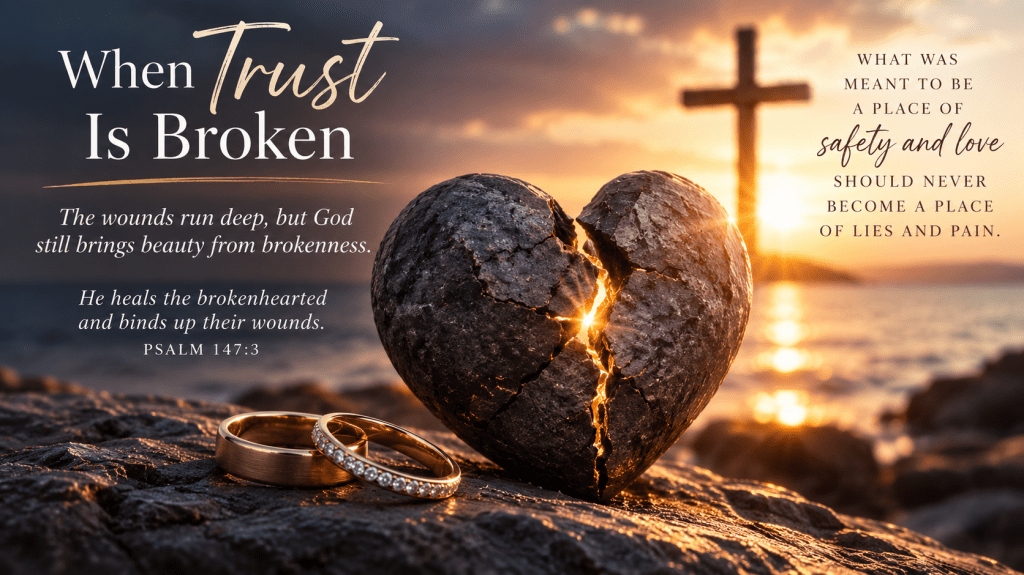
When Trust Is Broken

Trust is one of the most sacred gifts exchanged within a covenant marriage. It isn’t built overnight, and it isn’t sustained by words alone. It is earned through consistency, honesty, sacrifice, and love. When a husband and wife give themselves fully to one another, they create a place of refuge—a relationship where both feel safe to be vulnerable, truly seen, deeply heard, and completely accepted.

This is God’s design.

Marriage was never meant to be a battlefield where lies, deception, manipulation, and betrayal slowly replace intimacy. It was created to be a holy covenant where two people become one, with Christ at the center. When both husband and wife continually pursue God, they naturally grow closer to each other. There is little room for the enemy to gain a foothold because every part of the marriage is surrendered to the One who holds it together.

But when deception enters, everything begins to change.

Trust, once broken, leaves a wound that cannot simply be ignored. Even when healing comes, scars often remain. Those scars don’t mean restoration is impossible, but they do remind us that something sacred was violated. What God intended to be a place of security becomes a place of uncertainty.

Repeated deception doesn’t just damage a marriage—it slowly damages the heart of the one living through it.

Over time, constant lies and manipulation begin to rot you from the inside out. You start questioning everything. You question your memories. You question your instincts. You question your worth. You wonder if you’re asking for too much or expecting too much. You replay conversations in your mind, searching for what was real and what wasn’t.

Eventually, you begin questioning your identity.

The confidence you once carried slowly fades beneath the weight of broken promises and shattered expectations. You stop recognizing the person staring back at you in the mirror because you’ve spent so long trying to survive someone else’s choices. The emotional exhaustion becomes overwhelming. You feel lonely even when you’re sitting beside the person you married. You feel unseen, unheard, unloved, and abandoned by the one who once promised to protect your heart.

That is what betrayal does.

It doesn’t just break trust—it fractures the very foundation you believed your life was built upon.

Yet even here, God meets us.

While people can shatter our trust, they cannot steal our identity unless we allow them to define it. Our value has never been determined by someone else’s faithfulness but by God’s unchanging love for us. He sees every hidden tear, every sleepless night, every moment spent wondering if things will ever be different.

Psalm 34:18 reminds us:

“The Lord is near to the brokenhearted and saves those who are crushed in spirit.”

If you are living with the wounds of betrayal, know this: your pain is real, and your scars are not invisible to God. He understands the grief of broken covenant because He, too, has experienced the unfaithfulness of those He loves. Yet He is still in the business of restoring what sin has broken.

Healing may not erase the scars, but God has a beautiful way of transforming scars into testimonies of His faithfulness.

Your trust may have been shattered by a person, but it can be rebuilt through the One who has never broken a single promise.

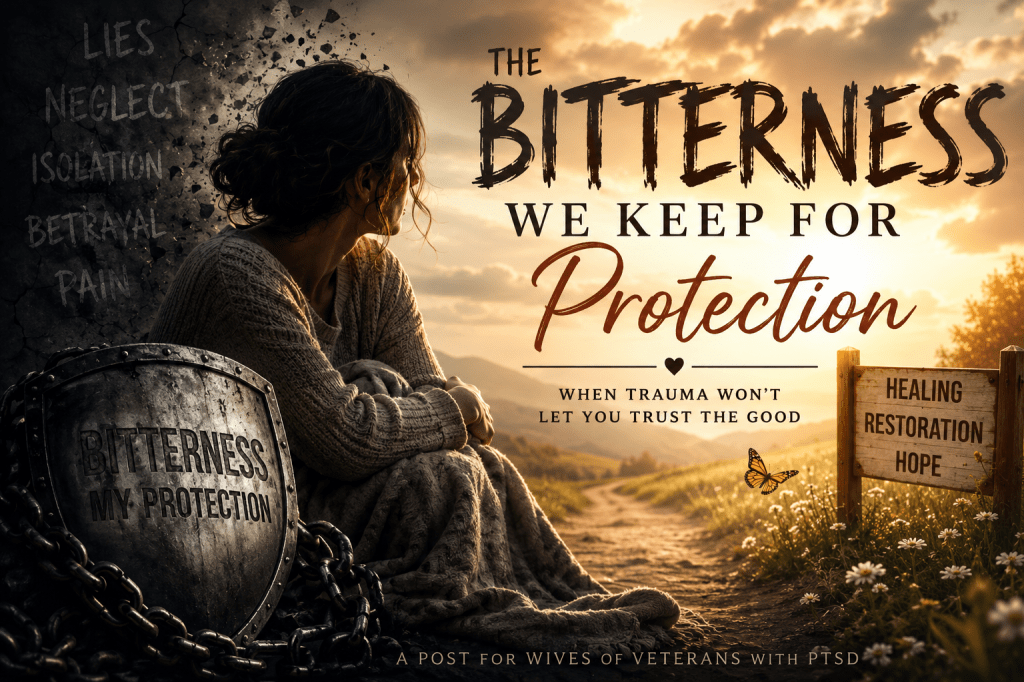
The Bitterness We Keep for Protection

It’s difficult not to carry bitterness after years of lies, isolation, disappointment, and neglect. Even when progress finally begins to happen—when you start to see the changes you’ve prayed for over countless sleepless nights—your trauma-fogged mind doesn’t immediately celebrate. Instead, it whispers, What if this doesn’t last? What if this all falls apart again?

Before long, those whispers become screams. Don’t trust it. Don’t believe it. You’re going to suffer again.

It’s a fight-or-flight response that every wife living alongside PTSD understands. It’s that familiar feeling of being pulled back into the darkness just when you thought you had finally found your footing. You try so hard to climb out of the hole, only to find yourself peering back over the edge, waiting for the ground to give way beneath you again.

The truth is, that kind of bitterness doesn’t simply disappear when happiness or healing begins to emerge. It lingers quietly in the background, like a shadow waiting for the perfect opportunity to remind you why you built walls around your heart in the first place. It waits for one bad day, one harsh word, one familiar pattern, hoping to convince you that nothing has really changed after all.

Because when you’ve lived in survival mode for so long, joy itself can feel unsafe.

At the end of the day, the feelings of happiness, romance, love, being wanted, being needed, and finally being seen can sometimes feel like a mask you’re simply waiting to slip off. You’re bracing yourself for the moment when the only reality you’ve ever truly known comes rushing back. The bitterness you’ve held onto wasn’t always hatred—it was protection. It was armor. It was the emergency plan you kept hidden away because some part of you refused to trust that restoration could actually be real.

Trauma leaves wounds that do not always bleed where others can see them. They remain open beneath the surface, quietly whispering that you’ll never be enough, that you’re not safe, and that hope is dangerous.

But perhaps the greatest act of faith isn’t pretending those wounds don’t exist. Perhaps it’s choosing, one day at a time, to believe that God can heal the places we’ve spent years trying to protect ourselves from feeling.

Anxiety is a Thief

Anxiety is a thief.

It doesn’t always come crashing through the front door. It creeps in quietly… watching… waiting… like a lion stalking its prey. And then, in a split second—it pounces.

One moment you feel steady… the next, your heart is racing, your thoughts are spiraling, and the peace you thought you had is gone. It goes from zero to one hundred without warning, stealing your joy, shaking your clarity, and making you question your own sanity. Even something as simple as breathing—in… and out—can suddenly feel overwhelming.

The more you try to trace the root of the anxiety, the deeper you spiral. Thoughts begin to stack on top of each other: I should have done this differently… Why didn’t I see this sooner… What if I’m still not doing enough… And just like that, guilt creeps in, shame follows, and the weight becomes almost unbearable. The bitterness you thought you had released returns. The resentment you prayed through resurfaces. And it all reminds you of the mess you’re still standing in.

This is the place few people understand… unless they’ve lived it.

There is a place anxiety tries to take you—a place of complete overwhelm, where your thoughts turn against you. A place that whispers, “You can’t do this… You’re too far gone… You’ll never get out of this.” That place is where self-destruction begins. Not always outwardly… but internally.

For me, that breaking point is often the very place God meets me. Not when everything is together. Not when I have the answers. But in the middle of the spiral, in the middle of the fear, in the middle of the mess. It is only by His grace that I am able to pick myself up, shake off what tried to take me down, and face life again—not because everything is fixed, but because He is sustaining me.

“God is our refuge and strength, a very present help in trouble.” — Psalms 46:1

He is not distant in your anxiety. He is present in it.

Anxiety wants to make you prey. It wants you to stay in the valley—to sit in the fear, replay the thoughts, and believe the lies. Because if it can keep you there, it can keep you stuck. But you don’t have to live there. You may walk through the valley, but you were never meant to build a home in it.

“Yea, though I walk through the valley of the shadow of death, I will fear no evil: for thou art with me…” — Psalms 23:4

If you are the woman fighting anxiety that comes out of nowhere, carrying the weight of trauma or PTSD, trying to hold everything together while silently unraveling—hear this:

You are not crazy. You are not weak. And you are not alone.

Anxiety may come like a thief, but it does not get to take everything. Because even in your lowest moment, even in your most overwhelming spiral, God is still there—steady, present, and unshaken. And when everything else feels like it’s slipping… He will be the One who holds you together.

Her Silence

Silence isn’t harsh.

It isn’t cold.
It isn’t punishment.
It isn’t manipulation.

It is exhaustion.
It is grief.
It is quiet defeat after fighting battles no one else saw.

When her voice has been dismissed long enough…
When her emotions have been minimized…
When her needs have gone unmet…

Silence does not arrive loudly.

It creeps in.

Slowly.

She does not wake up one morning deciding to withdraw. She arrives there after trying. After explaining. After crying. After praying. After hoping.

And when nothing shifts… something inside of her does.

Silence becomes protection.

Not because she wants distance — but because she can no longer survive exposure.

Survivor mode is never a place she longs to be.

No woman dreams of becoming guarded. No wife desires to grow quiet. No heart hopes to become cautious with the very person it once felt safest with.

And yet, survivor mode often finds her.

It finds her when she realizes she must fight not just for the marriage — but for herself.

There is a particular kind of desperation in silence. It is the moment she realizes that if she does not guard her heart, she may lose herself entirely in the longing for what used to be.

But here is the sacred turning point:

If she finds the strength and courage not to disappear inside the silence… she will discover something unexpected there.

She will find herself.

Not the version shaped by disappointment.
Not the version shrinking to be understood.
Not the version constantly over-explaining her pain.

But a woman rebuilding.

A woman expecting.

Expecting growth in the quiet.
Expecting clarity in the stillness.
Expecting healing in the hidden places.
Expecting peace that does not depend on another person’s consistency.

There is hope in her silence.

Because silence is not the end — it is the reset.

Psalm 46:10 says,
“Be still, and know that I am God.”

Be still.

Not because the pain isn’t real.
Not because the marriage doesn’t matter.
Not because the hurt disappears.

But because in the stillness, God begins to restore what chaos tried to steal.

In the silence, He reminds her:

She is not invisible.
She is not irrational.
She is not too much.
She is not alone.

He meets her there — not in the shouting, not in the proving, not in the defending — but in the quiet surrender.

And slowly, what once felt like defeat becomes rebuilding.

She finds peace in the silence.
Growth in the silence.
Joy in the silence.
Hope in the silence.
Laughter in the silence.
A new breath of life in the silence.

The silence that once felt like loss becomes the place she rediscovers her strength.

And when she rises again, she will not rise hardened.

She will rise healed.

And that kind of woman?
She no longer fights to be heard.

She walks in peace — knowing the One who sees her never stopped listening.

Beyond the Cupboard Doors

“Come to me, all you who are weary and burdened, and I will give you rest.”
— Matthew 11:28 (NIV)


Loneliness brings with it a longing—for conversation, for connection, for someone who will simply listen. Often, we can be surrounded by people and yet feel completely isolated in the room. It’s in those moments that our thoughts tend to take over. A million things swirl through our minds—things we long to say out loud, hoping someone might care enough to hear them.

And so, we begin to ramble to ourselves.

Washing dishes. Sweeping the floor. Folding socks.
The simplest tasks of life become the closest thing to conversation we have. I found myself there—stuffing blankets into the cupboard, talking out loud, letting random thoughts spill into the air, fully aware that no one was listening. My mind jumped from one thought to the next until I suddenly stood still, suspended in a moment that felt detached from reality.

And then, I imagined walking into the fairytale land of Narnia.

Disappearing into the cupboard that stood before me—its presence faint, almost inviting. We often find ourselves dreaming of a place beyond reality, a place that offers escape from everything we carry inside. A world of redemption waiting just beyond the applewood doors. A life untouched by pain, fear, or disappointment.

If only it were that easy.

The weight of real life presses so heavily on our souls that we begin to create a delusion—believing there must be something better, something lighter, somewhere else. Yet, as we journey through this uncharted land of fantasy, we quickly discover that even it is plagued by an eternal winter. Betrayal comes from those closest to us. Innocence is stripped away by deeper magic. And the escape we longed for becomes nothing more than a reflection of our own broken reality.

And then—we see Aslan.

The creator. The redeemer.
The one who transforms this place of escape into a mirror of truth. Suddenly, it becomes clear: the sinner is desperate—for forgiveness, for redemption, for salvation. Desperate for a Savior willing to lay Himself down, taking on every sin of humanity.

I close the applewood doors.
I snap back to reality.

And in that moment, I realize my burdens were never meant to be carried into another world—they were meant to be laid at the altar. His grace is sufficient for me. Always. Every single day of my life.


Lord,
You see the quiet moments—the cupboards, the silence, the words spoken into empty rooms. You see the longing, the exhaustion, the places we wish we could escape from and the places we wish would save us. Help us to remember that true redemption is not found beyond imaginary doors, but at Your feet. Teach us to lay down what is heavy, to stop carrying what was never ours to hold, and to trust that Your grace is enough—right here, in this life, on this day. Amen.

The Mug

I sat back in my chair, staring at my favorite coffee mug for what felt like an eternity. It was a moment of complete disassociation—lost in silence, resting in a place of nothingness—as the words Stay ROOTED stared back at me.

So many days I’ve looked at that mug and read those words. Some mornings it brought encouragement; other mornings, it brought tears. Yet never had those words pierced me the way they did in that moment of solitude.

It was a moment of revelation. A moment of awe. One that made me feel the weight of my testimony.

A testimony that declares my circumstances have not swayed my faith, my hope, or my love—because they are firmly anchored in Jesus Christ.

As PTSD wives, we tend to question our lives, our thoughts, our faith… and sometimes even our character. When the battles begin to rage, or when we find ourselves lost in a lonely place, everything can feel shaken. Our spiritual stability, trust, faith, and hope—things we often look to our spouse to provide—are the very things we were meant to seek from the Father all along.

That coffee mug is a constant reminder to shift my focus—from my circumstances to God’s unfailing mercies. Staying rooted has drawn me closer to the One who never changes. It reminds me that even when everything around me feels uncertain, He remains steady.

Scripture puts it beautifully:

“Blessed is the one who trusts in the Lord,
whose confidence is in him.
They will be like a tree planted by the water
that sends out its roots by the stream.
It does not fear when heat comes;
its leaves are always green.
It has no worries in a year of drought
and never fails to bear fruit.”

Jeremiah 17:7–8 (NIV)

Staying rooted doesn’t mean the storms stop coming. It means we are anchored deep enough to withstand them. Like a tree planted by the water, drawing life from a source far greater than the heat, the drought, or the chaos around it.

And sometimes, God uses something as simple as a coffee mug to remind us exactly where our roots belong.

Father,
Help us stay rooted in You when life feels uncertain and heavy.
When the storms come and our hearts feel weary, remind us where our strength comes from.
Teach us to draw from Your living water instead of our circumstances.
Anchor our faith deep in You—steady, unshaken, and secure.
And in the quiet moments, when we feel alone or overwhelmed, gently remind us that You are near, faithful, and unchanging.
Amen.

“A quiet moment, a favorite mug, and a powerful reminder: stay rooted in Him. 🌿 Even in the storms, His mercies never fail. #StayRooted #FaithOverFear #AnchoredInChrist”

Fight Like David


“But I trust in your unfailing love;
my heart rejoices in your salvation.
I will sing the Lord’s praise,
for he has been good to me.”
Psalm 3:5–6 (NIV)

As I sit here enjoying a hot cup of coffee on what might be the largest snowstorm of my lifetime, I find myself thinking about King David. In all of his greatness, he still reached places of abandonment, fear, and deep vulnerability in the eyes of his enemies.

Oh, how I relate to this—knowing the Almighty God walks with me through life, yet often feeling as David did: alone, doubtful, abandoned, and vulnerable to the enemy.

I keep returning to the words David poured out to his God:

“How long, Lord? Will you forget me forever?
How long will you hide your face from me?
How long must I wrestle with my thoughts
and day after day have sorrow in my heart?” – Psalm 13:1-2 (NIV)

I feel David’s cry deep within my soul—that longing to know how long the suffering will last, how long the wrestling within the mind must continue. Sorrow slowly drains joy and opens the door just enough for the enemy to creep in. In those moments, I feel David’s vulnerability at the deepest levels of my being.

Although David was facing a literal army, I am fighting a spiritual warfare far fiercer than we can imagine. Spiritual battles knock at our doors every single day. And it is often in moments of weakness or complete abandonment that I’m reminded David still drew his strength from the Lord. His hope came from the Lord.

It is easy to offer hope and God’s grace to others through my own experiences, yet often nearly impossible to accept that same hope for myself. When my hope runs thin, I write from the trenches—allowing God to use my words to shine light into the lives of others.

But what about me?

I am humbled to realize that it is okay to feel.
To question.
To doubt.
To make mistakes.

It is okay to say:
“I am carrying too much alone.”
“I don’t want to be the strong one today.”
“I don’t want to fight another battle quietly.”
“I don’t want to be the one who always understands.”

I am allowed to feel.
Allowed to be weak.
Allowed to cry out to God, just as David did, in my despair.

And you have permission to do the same.

God longs for us to want Him, need Him, cry out to Him. He doesn’t expect perfection—He expects trust, faith, and vulnerability.

Be a David. Let your true feelings be heard. Speak them out loud to the Father and trust His perfect plan and timing.

Leanna Crawford’s song “Honest” feels especially fitting when entering a posture of worship in the pit of despair—when fear surrounds us and darkness feels heavy. It captures the raw tension of witnessing God’s power, faithfulness, and miracles in others’ lives while still holding onto the promise of our own victory.

Don’t give up.
Be a David.
Remain steadfast, persistent, faithful, honest—
and wake up every day expecting.

Father,
You see the battles we fight out loud and the ones we carry quietly.
You know the weariness, the doubt, the questions we’re afraid to say.
Meet us here—in our honesty, in our weakness, in our longing.
Give us the courage to cry out like David,
and the faith to trust You even when answers feel far away.
Teach us to rest in Your unfailing love
and to believe You are still good, even here.
Amen.