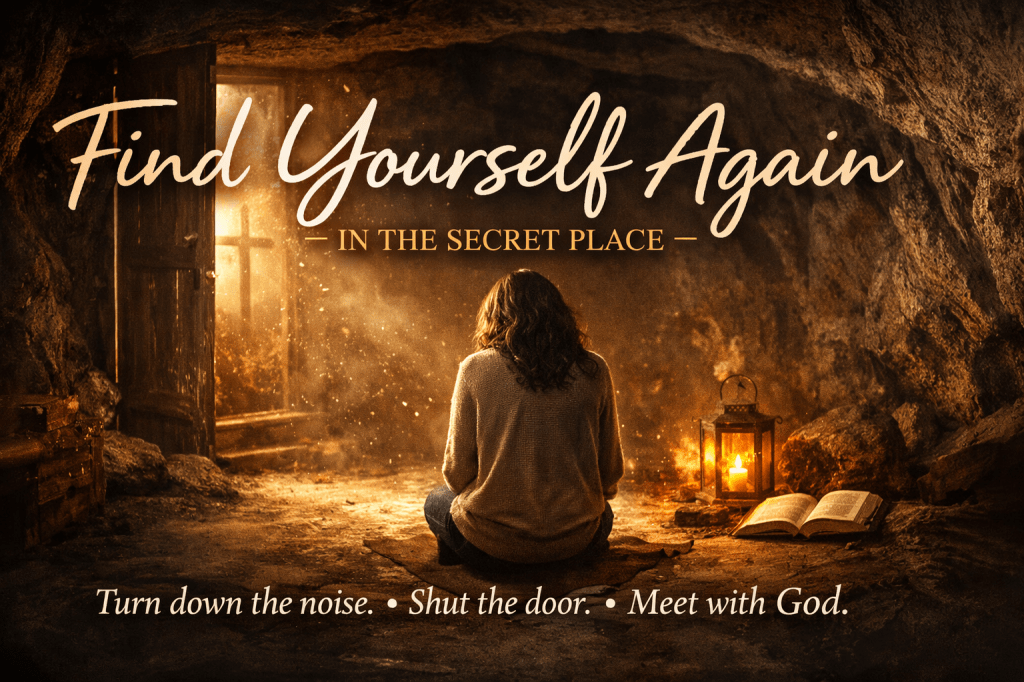
The Secret Place

Somewhere in the mess… you disappeared.

Between the responsibilities, the heartbreak, the expectations, and the silent battles no one sees—you got lost. Not all at once. But slowly. Quietly. Piece by piece.

And now you look in the mirror and barely recognize her.

Here is the truth no one wants to say out loud:
You will not find yourself in the noise.
You will not heal by staying busy.
You will not rise by pretending you’re fine.

You find yourself in the longing.

That ache deep inside that whispers, There has to be more than this.

We were never called to survive at surface level. Survival keeps you functioning—but it does not make you whole. It keeps you moving—but it does not make you free.

Freedom lives in the secret place.

Not a physical place. A sacred one. The place where only you and the Father have walked. The place you avoid because it feels too deep, too raw, too exposed.

But that is where she is.

The happy, carefree, full-of-life, Jesus-got-this kind of girl. She isn’t gone. She’s buried under fear, disappointment, and exhaustion.

Scripture says,

“He who dwells in the secret place of the Most High shall abide under the shadow of the Almighty.” — Psalm 91:1

Dwelling requires staying.
Staying requires courage.

It takes courage to sit still long enough to feel what you’ve been outrunning.
Courage to face the darkest parts of your own heart.
Courage to stop surviving and start seeking.

But healing does not happen on the surface.

It happens in the depths—the place where the tears fall freely and the masks come off. The place where you finally whisper the prayers you’ve been afraid to pray.

And there, in that quiet, the Father meets you.

Not with shame.
Not with disappointment.
But with presence.

Until you choose to rise and visit the hidden places of your soul, you will never rise from the ashes of the life you are living.

It is okay to feel.
It is okay to stop.
It is okay to take time for you.
To be quiet.
To be still.
To search.
To seek.
To pray.

Push yourself toward what makes you healthy. Safe. Stable. Whole.

Turn down the noise.
Shut the door.
Go to the secret place.

And stay.

Because when you do, the pieces begin to settle. The lies lose their grip. The chaos grows quiet.

And one day you will look in the mirror again—

And recognize her.

Not the woman who barely survived.
But the one who went into the depths…
and came back alive.

Her Silence

Silence isn’t harsh.

It isn’t cold.
It isn’t punishment.
It isn’t manipulation.

It is exhaustion.
It is grief.
It is quiet defeat after fighting battles no one else saw.

When her voice has been dismissed long enough…
When her emotions have been minimized…
When her needs have gone unmet…

Silence does not arrive loudly.

It creeps in.

Slowly.

She does not wake up one morning deciding to withdraw. She arrives there after trying. After explaining. After crying. After praying. After hoping.

And when nothing shifts… something inside of her does.

Silence becomes protection.

Not because she wants distance — but because she can no longer survive exposure.

Survivor mode is never a place she longs to be.

No woman dreams of becoming guarded. No wife desires to grow quiet. No heart hopes to become cautious with the very person it once felt safest with.

And yet, survivor mode often finds her.

It finds her when she realizes she must fight not just for the marriage — but for herself.

There is a particular kind of desperation in silence. It is the moment she realizes that if she does not guard her heart, she may lose herself entirely in the longing for what used to be.

But here is the sacred turning point:

If she finds the strength and courage not to disappear inside the silence… she will discover something unexpected there.

She will find herself.

Not the version shaped by disappointment.
Not the version shrinking to be understood.
Not the version constantly over-explaining her pain.

But a woman rebuilding.

A woman expecting.

Expecting growth in the quiet.
Expecting clarity in the stillness.
Expecting healing in the hidden places.
Expecting peace that does not depend on another person’s consistency.

There is hope in her silence.

Because silence is not the end — it is the reset.

Psalm 46:10 says,
“Be still, and know that I am God.”

Be still.

Not because the pain isn’t real.
Not because the marriage doesn’t matter.
Not because the hurt disappears.

But because in the stillness, God begins to restore what chaos tried to steal.

In the silence, He reminds her:

She is not invisible.
She is not irrational.
She is not too much.
She is not alone.

He meets her there — not in the shouting, not in the proving, not in the defending — but in the quiet surrender.

And slowly, what once felt like defeat becomes rebuilding.

She finds peace in the silence.
Growth in the silence.
Joy in the silence.
Hope in the silence.
Laughter in the silence.
A new breath of life in the silence.

The silence that once felt like loss becomes the place she rediscovers her strength.

And when she rises again, she will not rise hardened.

She will rise healed.

And that kind of woman?
She no longer fights to be heard.

She walks in peace — knowing the One who sees her never stopped listening.

The Dirty Window

Oftentimes I sit at the large kitchen island, directly across from a dirty window.

I sit there with great intention — determined to put my thoughts on paper. But more often than not, I find myself just staring… gazing for what feels like an eternity through that dirty window.

And as I sit here again, staring through the smudged glass, I begin to wonder why I have never mustered up enough motivation to clean it.

In an awkward, almost confusing way, I have come to realize something:

I find comfort in the dirty window.

As strange as that sounds, I’ve caught myself rationalizing it more than once. The dirty window has become a quiet form of consistency. And if I am honest, consistency is something my heart longs for more often than I would like to admit.

The window is imperfect — yet unchanging.
The beautiful view beyond it is clouded by spatter and streaks.
The mess blurs what could otherwise be clear.

And yet… it remains the same.

Then it hits me.

Life is the dirty window.

Each day brings its own spatter. Its own streaks. Its own unexpected splashes of chaos that we often have no idea how to cleanse. The more we try to wipe it away, sometimes the more smeared and cloudy it becomes.

We try to fix the mess.
We try to restore clarity.
We try to regain control.

But life lacks the consistency we crave.

Every new day holds unknown variables.
Unexpected conversations.
Unplanned disappointments.
Unforeseen struggles.

And that lack of consistency can create an environment that feels unsteady. Unstable. Unpredictable.

Yet at the end of the day, when I sit back down at the island and gaze through that same dirty window, there is something oddly comforting about its unchanged imperfection.

The mess is still there.
The smudges haven’t moved.
The view is still blurred.

And somehow, that consistency in the imperfection steadies me.

But here is what the Lord has been gently whispering to my heart:

While the window may remain dirty… He does not.

Our days may feel inconsistent.
Our emotions may fluctuate.
Our circumstances may cloud our vision.

But God is not unstable.

“The Lord is my refuge and my fortress, my God, in whom I trust.” — Psalm 91:2

Refuge.
Fortress.
Not shifting.
Not unpredictable.
Not clouded.

When life spatters our windows and blurs our view, it is easy to grow accustomed to the mess. We learn to live with the streaks. We adapt to the distortion. Sometimes we even mistake the familiar chaos for comfort.

But our true consistency is not found in the unchanging mess.

It is found in an unchanging God.

Hebrews 13:8 reminds us:

“Jesus Christ is the same yesterday and today and forever.”

Yesterday — when the window first got dirty.
Today — as we stare through it.
Forever — long after the smudges are gone.

Life may feel inconsistent.
Our emotions may feel unstable.
Our clarity may feel clouded.

But God remains steady in the middle of our scattered days.

And maybe — just maybe — the dirty window isn’t there to comfort me.

Maybe it is there to remind me that even when my view is blurred, my foundation is not.

Even in the mess.
Even in the unknown.
Even in the inconsistent chaos of each day.

He is steady.

And that is enough.

Loneliness

Loneliness is not something we choose. It is not something we crave. It is a dark and tender place we sometimes find ourselves in at the most unexpected moments of life. A place that feels cold. Heavy. Quiet in ways that echo too loudly.

It can feel impossible to carry the burdens we bear when there is no one beside us to help hold them.

In those moments, what we long for is simple—conversation. Connection. The kind of emotional safety that allows us to exhale. The kind of bonding that lets us be fully ourselves without fear of judgment. There is something sacred about genuine conversation. It reaches into the deepest parts of our loneliness. It reminds us we are seen. It can bring light to the worst of days and lift our spirits just enough to keep going.

Sometimes it’s the smallest things—a shared laugh, a thoughtful message, a few minutes of feeling understood. Little bursts of sunshine. Brief reminders that we are alive and that someone notices.

But when that connection fades… when the conversation stops… when what felt like your last lifeline slips away, the grief can take you by surprise.

You find yourself staring into the stillness of the day. Sitting in the car longer than necessary, gathering the strength to step back into normal life. Lying awake at night, alone with thoughts that replay what once was. And in those quiet hours, you feel grief—not only for the person or connection you lost, but for who you were in that season… and for what you hoped it might become.

It is grief for what was.
Grief for what could have been.
Grief for the version of you that felt less alone.

And yet, even there—in the quiet car, in the sleepless night, in the ache you can’t quite name—Scripture whispers something steady and true:

“The Lord is close to the brokenhearted and saves those who are crushed in spirit.” — Psalm 34:18

Close. Not distant.
Near. Not absent.

When loneliness convinces you that you are unseen, God draws nearer still. When your spirit feels crushed under the weight of loss, He does not turn away from your grief—He moves toward it.

And in those desperate, fragile moments, a question rises in the silence:

How far are you willing to go for connection?
How much of yourself are you willing to trade just to not feel alone?

Loneliness can tempt us to reach for anything that promises relief. But not every connection is healthy. Not every conversation is safe. Not every lifeline leads to life.

Sometimes the bravest thing we can do in our loneliness is pause. To remember that our longing for connection was placed in us by God—not to drive us toward desperation, but toward healthy, life-giving relationships. Toward Him first. Toward people who reflect His heart.

You are not weak for feeling lonely.
You are human.

And even in the quiet, unseen places, you are not abandoned. He is close.

Beyond the Cupboard Doors

“Come to me, all you who are weary and burdened, and I will give you rest.”
— Matthew 11:28 (NIV)


Loneliness brings with it a longing—for conversation, for connection, for someone who will simply listen. Often, we can be surrounded by people and yet feel completely isolated in the room. It’s in those moments that our thoughts tend to take over. A million things swirl through our minds—things we long to say out loud, hoping someone might care enough to hear them.

And so, we begin to ramble to ourselves.

Washing dishes. Sweeping the floor. Folding socks.
The simplest tasks of life become the closest thing to conversation we have. I found myself there—stuffing blankets into the cupboard, talking out loud, letting random thoughts spill into the air, fully aware that no one was listening. My mind jumped from one thought to the next until I suddenly stood still, suspended in a moment that felt detached from reality.

And then, I imagined walking into the fairytale land of Narnia.

Disappearing into the cupboard that stood before me—its presence faint, almost inviting. We often find ourselves dreaming of a place beyond reality, a place that offers escape from everything we carry inside. A world of redemption waiting just beyond the applewood doors. A life untouched by pain, fear, or disappointment.

If only it were that easy.

The weight of real life presses so heavily on our souls that we begin to create a delusion—believing there must be something better, something lighter, somewhere else. Yet, as we journey through this uncharted land of fantasy, we quickly discover that even it is plagued by an eternal winter. Betrayal comes from those closest to us. Innocence is stripped away by deeper magic. And the escape we longed for becomes nothing more than a reflection of our own broken reality.

And then—we see Aslan.

The creator. The redeemer.
The one who transforms this place of escape into a mirror of truth. Suddenly, it becomes clear: the sinner is desperate—for forgiveness, for redemption, for salvation. Desperate for a Savior willing to lay Himself down, taking on every sin of humanity.

I close the applewood doors.
I snap back to reality.

And in that moment, I realize my burdens were never meant to be carried into another world—they were meant to be laid at the altar. His grace is sufficient for me. Always. Every single day of my life.


Lord,
You see the quiet moments—the cupboards, the silence, the words spoken into empty rooms. You see the longing, the exhaustion, the places we wish we could escape from and the places we wish would save us. Help us to remember that true redemption is not found beyond imaginary doors, but at Your feet. Teach us to lay down what is heavy, to stop carrying what was never ours to hold, and to trust that Your grace is enough—right here, in this life, on this day. Amen.

Depths of the Sea

If I make my bed in the depths, You are there.”
— Psalm 139:8 (NIV)

That feeling. That thought. That deep emotion that instantly takes you to your secret place.

The place you go to escape — to not exist, to not feel. The place you only visit in desperate moments, when reality feels heavy, hopeless, breathless. A place that somehow feels both lifeless and powerful as you control each breath, taking in the oxygen your body so desperately craves.

It’s like sitting at the bottom of a vast body of water, drowning out everything in existence except the steady rhythm of your own breathing. Time freezes. The noise you’re escaping slowly fades into the distance while you soak in the silence, the darkness, the serenity of nothingness.

As the oxygen begins to dissipate, everything in you longs to stay there — alone, silent, suspended, lifeless.

Then, in a single moment, comes the gasp. Fresh air floods your lungs. Life rushes back in. Reality hits like a brick.

And it’s in that moment you realize something powerful: you were still in control of your chaos.

That brief glimpse of nothingness — the stillness you longed for — was given for only a moment. And as your lungs refill, you’re reminded of the gift of life… the miracle of breath.

It is in moments like this that I truly appreciate life. The awareness that tomorrow is never promised. The understanding that my time here on earth rests fully in the hands of my Master.

These moments bring clarity — a deep appreciation for breath, for choice, for life itself. Even in the darkest places, God’s mercy and grace never fail. They sustain me. They call me to choose Him. To choose life in the chaos.

And even when it feels like there is no way forward — only the deep darkness of a silent sea — He walks with me through every weary step of my journey. Even in the deepest, darkest waters.

One of my go-to encouragement songs says:

“And I’ll testify of the battles You’ve won,
How You were my portion when there wasn’t enough.
And I’ll testify of the seas that we’ve crossed,
The waters You parted, the waves that I’ve walked.”

In my deepest moments of desperation — at the bottom of what feels like an endless sea — God parts the waters. He gives breath to my lungs and strength to walk the waves once again.

It is only through complete surrender that I release control and hand my battles over to Him.

You will face battles. You will suffer moments of desperation. You may even feel as though your time on this earth should end.

Let this be your reminder: breathe. Just breathe.

There is a God who sees you, hears you, and fights for you. A God who parts waters, restores breath, and gives strength to rise again. Even when you feel buried in the depths of the sea, He fills your lungs and leads you back to the surface.

Put your faith in Him.
Allow Him to be your breath.

Longing for Home

As I sit here in the chaos of life… love… and marriage, my mind drifts back to the past. I lived a life of deep fulfillment as a child—truly the best life. A life any child would long for. I was raised by the most loving Christian parents, in a small town, living a country life on a farm at the end of a long gravel drive.

I lived carefree, spending my days outdoors—swimming in the pond, walking through the woods to the waterfall that became my place of serenity. Winters were warm and comforting, centered around a massive fireplace. I would nestle under a blanket my mom had warmed by the fire, hot cocoa in hand after long days of sledding, snowball fights, ice skating on the pond, and hours of fort building. While some people dreaded the cold, dreary winters, they held some of the happiest days of my life.

Home cooking, gardening, and sitting on the porch swing breaking beans and shucking corn with my mom, grandma, and older sister brought such joy to my heart. And the clubhouses in the barn lofts—oh, the hours spent outdoors making memories that truly last a lifetime. When I think of happiness, I think of home. Home is where my heart is. It’s not just a place—it’s a feeling. A deep sense of belonging. A love so secure it felt like the safest place on earth.

Marriage should feel like home. It should be the one place where you feel safe, secure, loved, seen, and heard. Home has no boundaries—it welcomes you back no matter the distance traveled or the mistakes made along the way. But often, relationships are built on fragile foundations or endure so much trauma and heartache that “home” begins to feel unreachable.

This is the quiet reality many PTSD wives live with—long years of suffering alongside the one who once was your home. We find ourselves longing for home again, yearning for that place where we feel secure, loved, connected, seen, and safe. Do you ever feel that ache? That deep longing for a conversation, intimacy, or simply the warmth of being wrapped in a blanket by that childhood fireplace?

You are not alone. This is a place many PTSD wives find themselves—a lonely place that, in our most desperate moments, can only be filled by our Heavenly Father. In those moments, let God be your dwelling place—your “home.” When the earthly home you long for feels distant or broken, He remains constant, steady, and near. His presence becomes the refuge where your heart can rest, where you are seen, known, and held, even when everything else feels uncertain.

My desire is to help bridge the gap between your loneliness and home. To be an ear that listens and a voice of encouragement when it is needed most.

How do you navigate the longing for “home”? Do you wish you had a support group of wives walking the same road to help ease the silent suffering? Share in the comments—what do you struggle with most?

“Lord, You have been our dwelling place throughout all generations.”
— Psalm 90:1

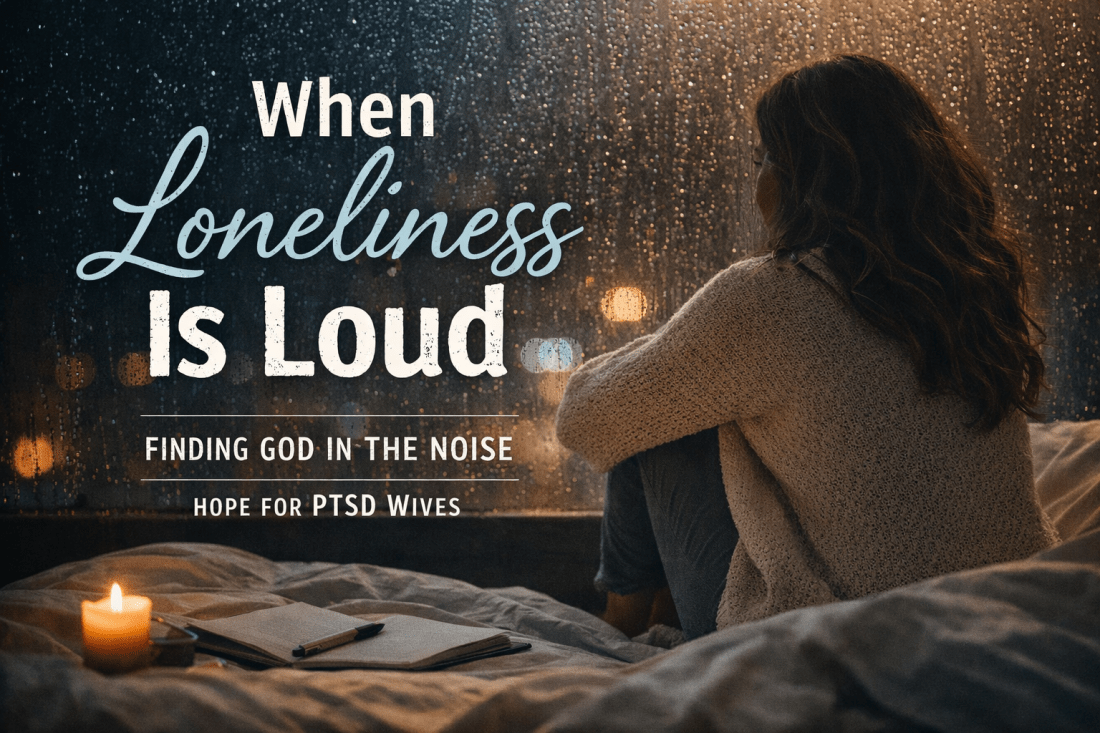
When Loneliness is Loud

You know those moments—hours, days, or even weeks—when the noise in your mind keeps you from just about everything you should be doing, praying, or even thinking? I often find myself whispering, “Silence the noise in my mind, Lord… please silence the noise in my mind.” All I really want is complete stillness. Maybe—just maybe—in that silence I could hear the small, sweet voice of my God in the middle of chaos and desperation.

The enemy loves to use loneliness as a tool. He uses it to make you feel like you are the only person on this entire planet who feels the way you do, who suffers the way you do. But when I lay my head down at night, God gives a peace that is indescribable and gently reminds me that I am not alone. I know that somewhere out there are hundreds, thousands—maybe even hundreds of thousands—of PTSD wives who feel alone, defeated, and abandoned.

We were not created for loneliness; we were created for companionship. A companionship meant to last a lifetime—one that grows deeper with love as each day passes. If you are a PTSD wife, you know your marriage has been robbed of the “happily ever after” you dreamed of as a little girl. It suffers in ways only those who have lived it can understand. It brings a loneliness into our lives that we never imagined possible. And when that companionship slips further and further away, we can become lost in the loneliness and begin to lose hope in the promises we were once given.

That is why I created this blog—not only to bring hope to those who are hurting, but to remind you that you are not alone. This is a safe place to share your thoughts, your hurts, and your heart. A place to connect with a community of sisters who truly understand—without judgment. Please don’t be afraid to comment, vent, ask questions, or even share a prayer request.

We are in this together.

“The Lord is near to the brokenhearted and saves those who are crushed in spirit.” — Psalm 34:18