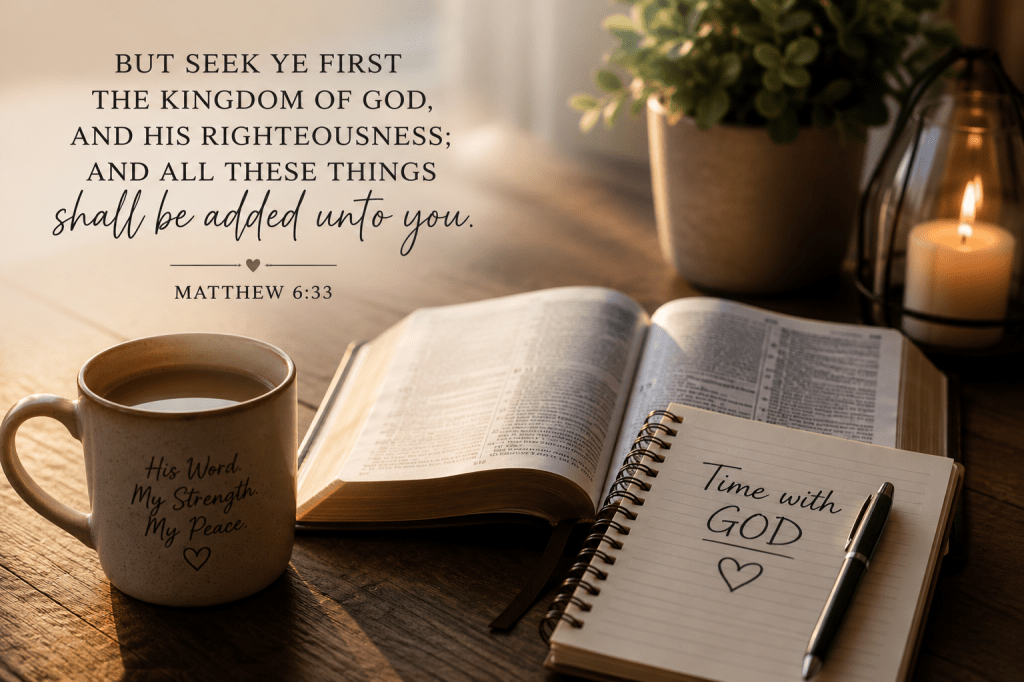
“But seek ye first the kingdom of God, and his righteousness; and all these things shall be added unto you.” — Matthew 6:33
There is something beautiful about this verse because Jesus doesn’t tell us to fit Him into the empty spaces of our lives.
He tells us to seek Him first.
Every evening, my youngest daughter sits down to do her homework.
This year she started fifth grade and was blessed with some pretty awesome teachers. One of the reasons they’re so awesome is because they’re passionate about what they do. They want their students to learn, grow, and succeed.
Along with great teachers comes something my daughter isn’t quite as excited about…
Homework.
Every night she has to read twenty pages from the book she’s currently reading.
With school only being back in session for a week, she’s still very much in summer mode. Almost every night I hear the same thing.
“Do I have to read all twenty pages?”
“I’m so tired.”
“I don’t want to read tonight.”
As her mom, my response is always the same.
“Yes, you do. It’s your homework. Reading is good for you, and it’s not optional.”
Then, in one of those moments that only God can orchestrate, He quietly spoke to my heart.
“What about you?”
For a second, I didn’t know how to answer.
Then, almost instinctively, I started giving God the very same excuses my daughter had just given me.
“I’ve been so busy.”
“The kids…”
“Work…”
“Sports…”
“Dinner…”
“The dishes…”
“The laundry…”
“I’ve been getting up at 5:45 every morning and going to bed late.”
Before I could justify myself any further, it was as if God gently responded with the very words I had just spoken to my daughter.
“It’s homework. It’s not optional. My Word is good for you.”
Ouch.
If that wasn’t a loving conviction, I don’t know what was.
How often do we faithfully complete everything the world requires of us while neglecting the one thing our souls need most?
We show up for work.
We get the kids where they need to be.
We wash the laundry.
We cook the meals.
We answer the emails.
We keep the house running.
We make sure everyone else fulfills their responsibilities.
Yet when it comes to spending time with God, somehow it’s the first thing we convince ourselves can wait until tomorrow.
The truth is, if my daughter skipped her homework every night because she was tired, eventually it would affect her growth.
The same is true for us.
We can’t expect to grow spiritually if we continually skip the very thing God uses to grow us.
The difference is that my daughter has me.
She has someone who reminds her.
Encourages her.
Holds her accountable.
As adults, no teacher is collecting our Bible reading the next morning.
No one is checking whether we spent time with the Lord before the day began.
That kind of accountability has to come from within.
Life is busy.
Our calendars are full.
By the end of the day, we’re running on fumes.
But maybe that’s exactly why God asks us to come to Him.
Not because He needs our time…
Because we need Him.
The beautiful thing is that God isn’t asking for perfection.
He isn’t waiting for the laundry to be folded, the dishes to be washed, or the house to be quiet before He invites us into His presence.
He simply asks us to come.
Sometimes it’s twenty minutes.
Sometimes it’s ten.
Sometimes it’s one chapter before the day begins.
Sometimes it’s a whispered prayer while folding laundry.
But whatever it looks like, it shouldn’t become the leftover part of our day.
It should become the foundation of it.
As parents, we lovingly teach our children that some things are too important to skip, even when they’re tired.
Maybe it’s time we start holding ourselves to that same standard.
Because God’s Word isn’t another task to check off our list.
It’s the very thing that gives us the strength, wisdom, and peace to face everything else on it.
So tomorrow morning, before you check your email…
Before you start the laundry…
Before you tackle the endless to-do list…
Remember what God so gently reminded me.
It’s homework.
It’s not optional.
🎵 Worship that encouraged me this week: “First Things First” by Consumed By Fire. Sometimes I need the reminder that before the laundry, before the emails, before the endless to-do list… God simply asks for my heart first.
I have taken full control of them because addiction made it necessary.
We’ve done rehab.
We’ve done therapy.
We’ve involved family.
We’ve brought other people into the situation for accountability.
We’ve had the conversations.
We’ve cried.
We’ve prayed.
We’ve made plans.
We’ve talked about consequences.
We’ve had promises made after painful discoveries.
We’ve tried things that were supposed to help.
And still…
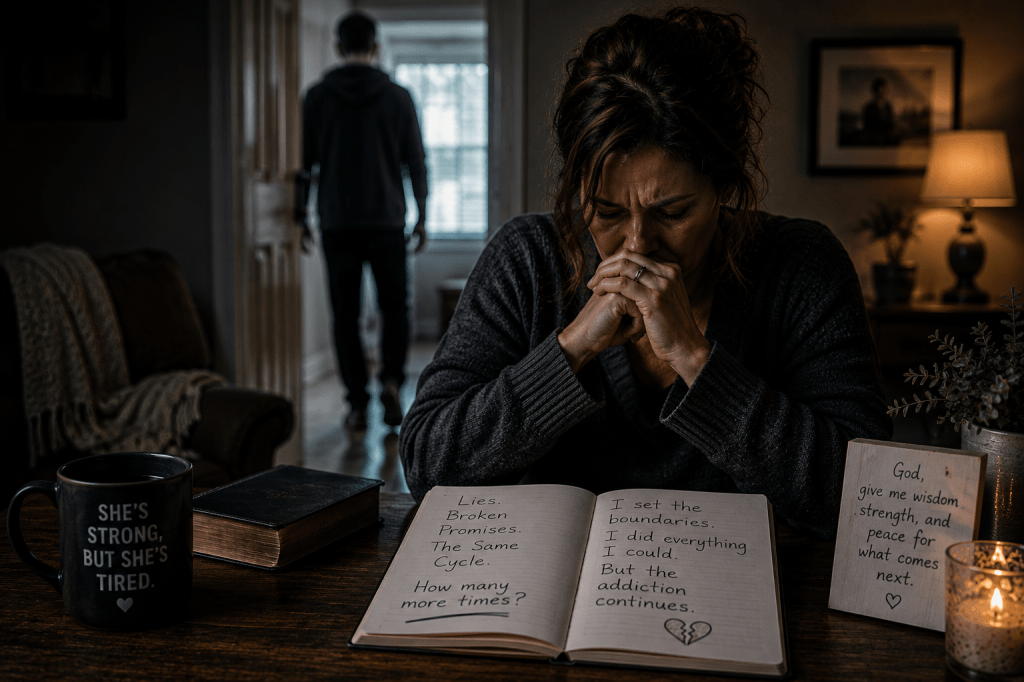
the addiction continues.
The lies continue.
That’s the part I’m struggling to understand now.
Because eventually you run out of smaller boundaries.
There comes a point where you’ve already moved the money. You’ve already created accountability. You’ve already encouraged treatment. You’ve already stopped hiding everything from the people closest to you.
And you’re still standing there looking at the same behavior.
So what boundary comes next?
That question terrifies me.
When You’ve Done Everything Except Leave
Maybe that’s the part I haven’t wanted to say out loud.
What happens when you’ve done almost everything you know to do except physically remove yourself from the cycle?
That’s a much harder question than, “How do I set a boundary?”
Because I know how to set boundaries now.
I know how to protect the finances.
I know how to say no.
I know how to involve other people.
I know how to encourage treatment.
I know how to recognize manipulation much faster than I used to.
What I don’t always know is what to do when none of it changes the person I love.
There is a painful realization that comes with that:
Maybe the purpose of my boundaries was never to make him change.
I think somewhere inside me, I still believed they would.
If I controlled the finances, maybe the gambling would stop.
If enough people knew, maybe the accountability would stop the lying.
If he went to rehab, maybe he would finally understand.
If therapy uncovered the deeper issues, maybe everything would begin to change.
If he saw how close he came to losing his marriage, surely that would be enough.
But what happens when it isn’t?
What happens when every safeguard you put into place becomes another obstacle the addiction learns how to work around?
That is when boundaries stop feeling empowering and start feeling heartbreaking.
Because I am forced to confront something I desperately don’t want to be true:
I can make it harder for addiction to destroy our lives, but I cannot make another person choose recovery.
I Cannot Boundary Someone Into Recovery
That sentence hurts to write.
I cannot boundary someone into recovery.
I cannot monitor someone into honesty.
I cannot control the finances enough to create integrity.
I cannot make accountability work if someone is determined to hide.
I cannot love someone into telling the truth.
I cannot find the perfect therapist, rehabilitation center, consequence, Bible verse, conversation, or arrangement that will make someone choose something they are unwilling to choose for themselves.
And maybe that’s why this stage feels so different.
In the beginning, there was always another thing to try.
Another conversation.
Another boundary.
Another safeguard.
Another treatment.
Another chance.
Doing something made me feel like there was still something I could control.
But eventually you arrive at a place where the question isn’t:
“What else can I do to stop him?”
It becomes:
“What am I going to do if he doesn’t stop?”
And I don’t like that question nearly as much.
Because that question is about me.
The Apology Doesn’t Fix It Anymore
There was a time when an apology brought relief.
Maybe this time he understood.
Maybe this was rock bottom.
Maybe losing this much would finally be enough.
Maybe seeing me this broken would finally make something click.
But after enough cycles, apologies begin to feel different.
You want to believe them.
Part of you still does.
But another part of you is quietly keeping track of everything that came before.
You remember the other apologies.
The other promises.
The other “last times.”
The other moments when you thought the nightmare was finally ending.
So you’re standing there listening to someone say they’re sorry while two completely different voices are fighting inside you.
One says:
Give him grace.
People mess up.
Addiction is hard.
Marriage means fighting for each other.
God can still restore this.
And the other says:
We’ve been here before.
That second voice used to make me feel guilty.
Now I’m beginning to wonder if that voice isn’t bitterness at all.
Maybe it’s discernment.
Maybe wisdom sometimes remembers the pattern even when your heart desperately wants to believe the promise.
When Hope Starts Keeping You Stuck
This is difficult for me to admit because hope sounds like such a beautiful Christian word.
And it is.
I believe in hope.
I believe God changes people.
I believe marriages can be restored.
I believe addicts can recover.
I believe broken things can become beautiful again.
But I’m beginning to understand that hoping someone changes and living as though they already have are two very different things.
I can hope for recovery without pretending recovery is happening.
I can pray for honesty while acknowledging that I’m still being lied to.
I can believe God can restore my marriage without calling the current situation restored.
Maybe faith isn’t denying what is happening because I’m afraid of what acknowledging it might require me to do.
Maybe faith is trusting God enough to tell the truth about what is happening.
This Is Where Avoidance Gets Really Uncomfortable
Because when all the smaller boundaries have already been put into place, there aren’t many comfortable options left.
That’s when my avoidant side wants to bargain.
Maybe give it a little more time.
Maybe this apology is different.
Maybe therapy will eventually click.
Maybe I need to be more understanding.
Maybe I’m expecting too much too quickly.
Maybe I should just be thankful for the good days.
Some of those thoughts may occasionally contain truth.
Recovery isn’t perfect.
People do stumble.
Change takes time.
But there is also a difference between an imperfect recovery and an ongoing pattern of addiction, deception, and manipulation without sustained change.
I have to be careful that compassion doesn’t become the excuse I use to avoid making a decision.
Because eventually, “give it more time” can become years.
The Boundary I’m Afraid Of
Maybe this is where I am learning that the hardest boundary isn’t controlling money.
It isn’t demanding treatment.
It isn’t telling family.
It isn’t even saying, “I won’t tolerate this anymore.”
The hardest boundary may be accepting what I will have to do if nothing changes.
I don’t write that lightly.
I don’t believe marriage should be discarded because things become difficult.
I don’t believe struggling with addiction makes someone unworthy of love.
And I certainly don’t believe every wife reading this should make the same decision.
But I also no longer believe that loving someone requires me to endlessly absorb the consequences of choices I cannot control.
There is a point where I have to stop asking:
“What else can I do to make him change?”
and start asking:
“God, what are You asking me to do if he chooses not to?”
That prayer scares me.
Because I have spent so much time praying for God to change him.
Maybe now I also need the courage to ask God to show me what obedience looks like for me.
Maybe Boundaries Were Never About Saving My Marriage
I wanted boundaries to save my marriage.
I wanted treatment to save it.
I wanted accountability to save it.
I wanted controlling the finances to save it.
I wanted therapy to save it.
I wanted love, patience, forgiveness, prayer, consequences, and second chances to eventually add up to transformation.
But none of those things can substitute for another person’s willingness to change.
Maybe boundaries aren’t how I save my marriage.
Maybe boundaries are how I stop losing myself while I wait to see what the other person chooses.
And maybe that is what I am finally beginning to understand.
I can love him.
I can pray for him.
I can forgive him.
I can hope for him.
I can believe with everything inside me that God is capable of completely transforming his life.
And I can still tell the truth about what is happening right now.
The addiction continues.
The lies continue.
The boundaries haven’t produced the change I hoped they would.
And I cannot keep pretending that an apology is the same thing as recovery.
Maybe the next step isn’t another rule for him.
Maybe it’s finally asking God what He wants from me when I have done everything I know to do—and the person I love still chooses the addiction.
I don’t have a neat answer to that yet.
Maybe that’s okay.
Maybe understanding myself begins with finally being willing to ask the question.
It isn’t cold. It isn’t punishment. It isn’t manipulation.
It is exhaustion. It is grief. It is quiet defeat after fighting battles no one else saw.
When her voice has been dismissed long enough… When her emotions have been minimized… When her needs have gone unmet…
Silence does not arrive loudly.
It creeps in.
Slowly.
She does not wake up one morning deciding to withdraw. She arrives there after trying. After explaining. After crying. After praying. After hoping.
And when nothing shifts… something inside of her does.
Silence becomes protection.
Not because she wants distance — but because she can no longer survive exposure.
Survivor mode is never a place she longs to be.
No woman dreams of becoming guarded. No wife desires to grow quiet. No heart hopes to become cautious with the very person it once felt safest with.
And yet, survivor mode often finds her.
It finds her when she realizes she must fight not just for the marriage — but for herself.
There is a particular kind of desperation in silence. It is the moment she realizes that if she does not guard her heart, she may lose herself entirely in the longing for what used to be.
But here is the sacred turning point:
If she finds the strength and courage not to disappear inside the silence… she will discover something unexpected there.
She will find herself.
Not the version shaped by disappointment. Not the version shrinking to be understood. Not the version constantly over-explaining her pain.
But a woman rebuilding.
A woman expecting.
Expecting growth in the quiet. Expecting clarity in the stillness. Expecting healing in the hidden places. Expecting peace that does not depend on another person’s consistency.
There is hope in her silence.
Because silence is not the end — it is the reset.
Psalm 46:10 says, “Be still, and know that I am God.”
Be still.
Not because the pain isn’t real. Not because the marriage doesn’t matter. Not because the hurt disappears.
But because in the stillness, God begins to restore what chaos tried to steal.
In the silence, He reminds her:
She is not invisible. She is not irrational. She is not too much. She is not alone.
He meets her there — not in the shouting, not in the proving, not in the defending — but in the quiet surrender.
And slowly, what once felt like defeat becomes rebuilding.
She finds peace in the silence. Growth in the silence. Joy in the silence. Hope in the silence. Laughter in the silence. A new breath of life in the silence.
The silence that once felt like loss becomes the place she rediscovers her strength.
And when she rises again, she will not rise hardened.
She will rise healed.
And that kind of woman? She no longer fights to be heard.
She walks in peace — knowing the One who sees her never stopped listening.
“But I trust in your unfailing love; my heart rejoices in your salvation. I will sing the Lord’s praise, for he has been good to me.” – Psalm 3:5–6 (NIV)
As I sit here enjoying a hot cup of coffee on what might be the largest snowstorm of my lifetime, I find myself thinking about King David. In all of his greatness, he still reached places of abandonment, fear, and deep vulnerability in the eyes of his enemies.
Oh, how I relate to this—knowing the Almighty God walks with me through life, yet often feeling as David did: alone, doubtful, abandoned, and vulnerable to the enemy.
I keep returning to the words David poured out to his God:
“How long, Lord? Will you forget me forever? How long will you hide your face from me? How long must I wrestle with my thoughts and day after day have sorrow in my heart?” – Psalm 13:1-2 (NIV)
I feel David’s cry deep within my soul—that longing to know how long the suffering will last, how long the wrestling within the mind must continue. Sorrow slowly drains joy and opens the door just enough for the enemy to creep in. In those moments, I feel David’s vulnerability at the deepest levels of my being.
Although David was facing a literal army, I am fighting a spiritual warfare far fiercer than we can imagine. Spiritual battles knock at our doors every single day. And it is often in moments of weakness or complete abandonment that I’m reminded David still drew his strength from the Lord. His hope came from the Lord.
It is easy to offer hope and God’s grace to others through my own experiences, yet often nearly impossible to accept that same hope for myself. When my hope runs thin, I write from the trenches—allowing God to use my words to shine light into the lives of others.
But what about me?
I am humbled to realize that it is okay to feel. To question. To doubt. To make mistakes.
It is okay to say: “I am carrying too much alone.” “I don’t want to be the strong one today.” “I don’t want to fight another battle quietly.” “I don’t want to be the one who always understands.”
I am allowed to feel. Allowed to be weak. Allowed to cry out to God, just as David did, in my despair.
And you have permission to do the same.
God longs for us to want Him, need Him, cry out to Him. He doesn’t expect perfection—He expects trust, faith, and vulnerability.
Be a David. Let your true feelings be heard. Speak them out loud to the Father and trust His perfect plan and timing.
Leanna Crawford’s song “Honest” feels especially fitting when entering a posture of worship in the pit of despair—when fear surrounds us and darkness feels heavy. It captures the raw tension of witnessing God’s power, faithfulness, and miracles in others’ lives while still holding onto the promise of our own victory.
Don’t give up. Be a David. Remain steadfast, persistent, faithful, honest— and wake up every day expecting.
Father, You see the battles we fight out loud and the ones we carry quietly. You know the weariness, the doubt, the questions we’re afraid to say. Meet us here—in our honesty, in our weakness, in our longing. Give us the courage to cry out like David, and the faith to trust You even when answers feel far away. Teach us to rest in Your unfailing love and to believe You are still good, even here. Amen.
As I sit here in the chaos of life… love… and marriage, my mind drifts back to the past. I lived a life of deep fulfillment as a child—truly the best life. A life any child would long for. I was raised by the most loving Christian parents, in a small town, living a country life on a farm at the end of a long gravel drive.
I lived carefree, spending my days outdoors—swimming in the pond, walking through the woods to the waterfall that became my place of serenity. Winters were warm and comforting, centered around a massive fireplace. I would nestle under a blanket my mom had warmed by the fire, hot cocoa in hand after long days of sledding, snowball fights, ice skating on the pond, and hours of fort building. While some people dreaded the cold, dreary winters, they held some of the happiest days of my life.
Home cooking, gardening, and sitting on the porch swing breaking beans and shucking corn with my mom, grandma, and older sister brought such joy to my heart. And the clubhouses in the barn lofts—oh, the hours spent outdoors making memories that truly last a lifetime. When I think of happiness, I think of home. Home is where my heart is. It’s not just a place—it’s a feeling. A deep sense of belonging. A love so secure it felt like the safest place on earth.
Marriage should feel like home. It should be the one place where you feel safe, secure, loved, seen, and heard. Home has no boundaries—it welcomes you back no matter the distance traveled or the mistakes made along the way. But often, relationships are built on fragile foundations or endure so much trauma and heartache that “home” begins to feel unreachable.
This is the quiet reality many PTSD wives live with—long years of suffering alongside the one who once was your home. We find ourselves longing for home again, yearning for that place where we feel secure, loved, connected, seen, and safe. Do you ever feel that ache? That deep longing for a conversation, intimacy, or simply the warmth of being wrapped in a blanket by that childhood fireplace?
You are not alone. This is a place many PTSD wives find themselves—a lonely place that, in our most desperate moments, can only be filled by our Heavenly Father. In those moments, let God be your dwelling place—your “home.” When the earthly home you long for feels distant or broken, He remains constant, steady, and near. His presence becomes the refuge where your heart can rest, where you are seen, known, and held, even when everything else feels uncertain.
My desire is to help bridge the gap between your loneliness and home. To be an ear that listens and a voice of encouragement when it is needed most.
How do you navigate the longing for “home”? Do you wish you had a support group of wives walking the same road to help ease the silent suffering? Share in the comments—what do you struggle with most?
“Lord, You have been our dwelling place throughout all generations.” — Psalm 90:1
You know those moments—hours, days, or even weeks—when the noise in your mind keeps you from just about everything you should be doing, praying, or even thinking? I often find myself whispering, “Silence the noise in my mind, Lord… please silence the noise in my mind.” All I really want is complete stillness. Maybe—just maybe—in that silence I could hear the small, sweet voice of my God in the middle of chaos and desperation.
The enemy loves to use loneliness as a tool. He uses it to make you feel like you are the only person on this entire planet who feels the way you do, who suffers the way you do. But when I lay my head down at night, God gives a peace that is indescribable and gently reminds me that I am not alone. I know that somewhere out there are hundreds, thousands—maybe even hundreds of thousands—of PTSD wives who feel alone, defeated, and abandoned.
We were not created for loneliness; we were created for companionship. A companionship meant to last a lifetime—one that grows deeper with love as each day passes. If you are a PTSD wife, you know your marriage has been robbed of the “happily ever after” you dreamed of as a little girl. It suffers in ways only those who have lived it can understand. It brings a loneliness into our lives that we never imagined possible. And when that companionship slips further and further away, we can become lost in the loneliness and begin to lose hope in the promises we were once given.
That is why I created this blog—not only to bring hope to those who are hurting, but to remind you that you are not alone. This is a safe place to share your thoughts, your hurts, and your heart. A place to connect with a community of sisters who truly understand—without judgment. Please don’t be afraid to comment, vent, ask questions, or even share a prayer request.
We are in this together.
“The Lord is near to the brokenhearted and saves those who are crushed in spirit.” — Psalm 34:18
“He heals the brokenhearted and binds up their wounds.” — Psalm 147:3
Grief is not always suffered from the loss of someone you love dearly or hold close to your heart. Often, grief simply comes from the loss of something you once had. Memories are all around us and are brought to mind through simple things — a song once shared, a familiar smell that can never be forgotten, or even a single word that brings back a moment in time you hold dear.
For me, the deepest pain comes from living in the midst of what is grieved the most — the small, intimate moments, the touch, the security, the simplicity of being fully present in a moment where nothing else existed except the memory being created. Over the years, those memories intertwine with pain and trauma, with doubt and sorrow, until you begin to lose yourself in the scramble of what was and what is.
Those sweet memories are swallowed up by this thing we call life — or perhaps, the sins of the world. It steals the minds of those we hold close, whispers lies of defeat, and slowly turns memories into grief — a slow, painful grief that feels like an open wound that never heals. Every scab is a small glimpse of hope for what once was, knowing deep down it may never be again.
The silent suffering… every PTSD wife has felt this grief — longing for moments of the past and hoping for their return in the future. The despair cries out for even one more moment as it was, one more memory of what it should be. The quiet nights awake in silence turn into utter loneliness that leaves you clinging to God for that last bit of hope — the hope that brings comfort and peace.
When we grieve, we grieve not for a life that was lost, but for the love that once was.
As we grieve the memories of what once was, let us cling to God for what is to come. He has a love that surpasses all understanding. This worldly love we so desire to mend can become an overwhelming, perfect love in His presence. Fix your mind upon God in the loneliness of life. Allow Him to heal the wound that feels as if it can never heal. Pray for the love you once had to return — for God can move in mighty, unthinkable ways when we surrender our silent suffering and allow Him to fight our battles.
When the wages of war get heavy, you will often find yourself lost in the loneliness of the battlefield. If you silently remain there for too long, it becomes a dangerous place—a dark place—where the enemy creeps into the silence to destroy what you have worked so desperately to sustain.
It is in those moments that the small whispers of defeat grow louder—reminders of your failures, fears of your inadequacies, and worries about not possessing the strength to face another day. These thoughts strike when you are at your weakest.
And yet, it is in these very moments that you must gather what strength you have left to employ your most powerful weapon: prayer.
Your weakest prayers—those uttered from a place of complete desperation—are not ignored; they are heard, treasured, and cherished by your Heavenly Father. He longs to protect you from the evil one.
In the darkest moments of your marriage, you must prioritize your spiritual well-being—not only to guard your own heart but to shield your family from the lies of the enemy. This is how you claim victory over your life, over your marriage, and over your home. This is how you find the strength to pray fervently, even when it feels like you have nothing left to give.
The Bible tells us:
“Be very careful, then, how you live—not as unwise but as wise, making the most of every opportunity, because the days are evil.” (Ephesians 5:15-16)
Wives, we are warned in the living Word of God that our days on this earth are filled with evil. Every single day you will face battles against an enemy who wants to destroy your marriage, your faith, and your peace. That’s why, each day, you must make choices rooted deeply in faith—choices that put God first, then your spouse.
Your decision to stand in faith in the loneliest places—when no one else sees, when no one else knows—may be the very thing that brings hope, healing, and victory to your marriage.
There are moments in this life where the weight of spiritual warfare feels unbearable. I find myself paralyzed—not by what I see, but by the invisible war waged in my mind and spirit. It’s as if the enemy is constantly whispering lies of defeat into my ears. Without even realizing it, I begin to spiral—drawn into a pit of sorrow, pain, and overwhelming exhaustion. My heart races, my palms grow sweaty, and I close my eyes, taking deep breaths, wondering how I ended up in such a battle.
But even in that silence… the still, small voice of the Holy Spirit breaks through. And He reminds me who I am. I am loved. I am worthy. I am treasured. I am enough.
In that holy moment, I rise up and begin to declare victory over my life, my marriage, and my children. I remember that through faith in Jesus Christ, I hold the key to every victory. “The horse is made ready for the day of battle, but the victory belongs to the Lord” (Proverbs 21:31).
Ladies, hear me: you do not fight this battle alone.
When you step into the war for your marriage, your family, your peace—you’re entering a spiritual battlefield. And unless you’re prepared, the lies of the enemy will leave you paralyzed. But God is calling you to rise up. Prepare your horse. Put on your armor. Don’t let the pain of today keep you from the promise of tomorrow.
No matter how weary or broken you feel, seek the Lord. Stay steadfast in prayer. Immerse yourself in God’s Word. Set your mind and heart on the One who fights for you. Yes, some days it feels like you have no strength left to even pick up the saddle—but it is your faith that will carry you through. It is your faith that places the blood of Jesus over the doorway of your home. It is your faith that will break chains and set your husband free.
You may feel outnumbered. You may feel unseen. But let me assure you, heaven sees you. God is with you. And the victory is already won.
As the Bible tells us:
“Our struggle is not against flesh and blood, but against the rulers, against the powers, against the world forces of this darkness, against the spiritual forces of wickedness in the heavenly places.” (Ephesians 6:12)
So today, I challenge you—reject the lies of the enemy and rise up in truth. Declare victory over your life, your husband, and your marriage. This battle is not yours—it belongs to the Lord. And through Him… you will see a VICTORY.






 Life As A PTSD Wife