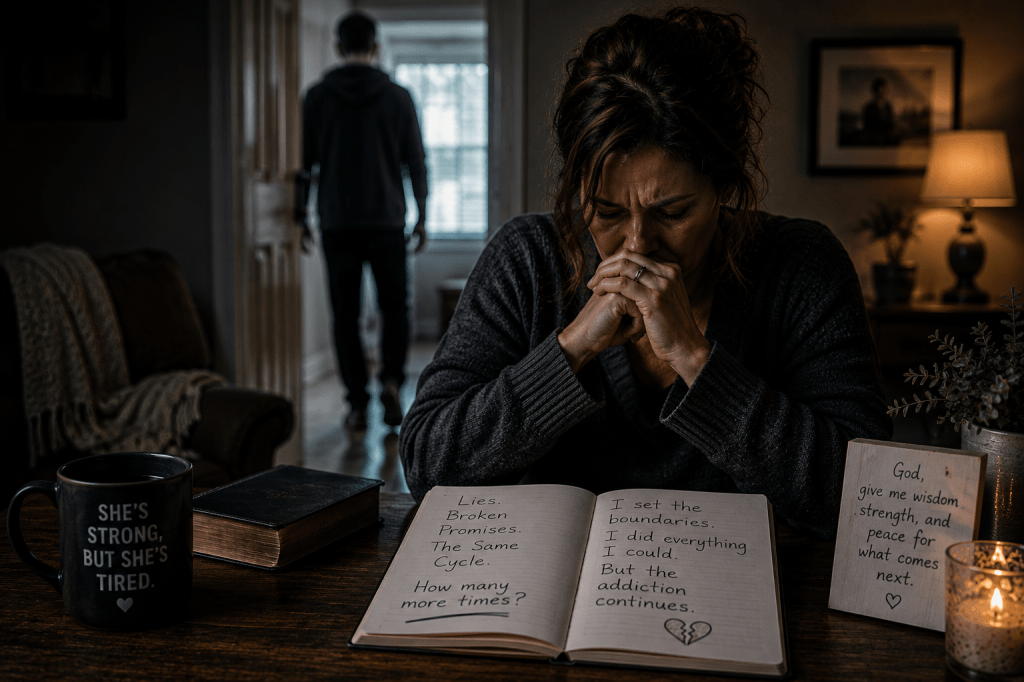
When Boundaries Aren’t Enough: Loving an Addict Who Keeps Crossing Them

But What If You’ve Already Done All of That?

This is where my story gets more complicated.

Because I have separated the finances.

Not partially.

I have taken full control of them because addiction made it necessary.

We’ve done rehab.

We’ve done therapy.

We’ve involved family.

We’ve brought other people into the situation for accountability.

We’ve had the conversations.

We’ve cried.

We’ve prayed.

We’ve made plans.

We’ve talked about consequences.

We’ve had promises made after painful discoveries.

We’ve tried things that were supposed to help.

And still…

the addiction continues.

The lies continue.

That’s the part I’m struggling to understand now.

Because eventually you run out of smaller boundaries.

There comes a point where you’ve already moved the money. You’ve already created accountability. You’ve already encouraged treatment. You’ve already stopped hiding everything from the people closest to you.

And you’re still standing there looking at the same behavior.

So what boundary comes next?

That question terrifies me.

When You’ve Done Everything Except Leave

Maybe that’s the part I haven’t wanted to say out loud.

What happens when you’ve done almost everything you know to do except physically remove yourself from the cycle?

That’s a much harder question than, “How do I set a boundary?”

Because I know how to set boundaries now.

I know how to protect the finances.

I know how to say no.

I know how to involve other people.

I know how to encourage treatment.

I know how to recognize manipulation much faster than I used to.

What I don’t always know is what to do when none of it changes the person I love.

There is a painful realization that comes with that:

Maybe the purpose of my boundaries was never to make him change.

I think somewhere inside me, I still believed they would.

If I controlled the finances, maybe the gambling would stop.

If enough people knew, maybe the accountability would stop the lying.

If he went to rehab, maybe he would finally understand.

If therapy uncovered the deeper issues, maybe everything would begin to change.

If he saw how close he came to losing his marriage, surely that would be enough.

But what happens when it isn’t?

What happens when every safeguard you put into place becomes another obstacle the addiction learns how to work around?

That is when boundaries stop feeling empowering and start feeling heartbreaking.

Because I am forced to confront something I desperately don’t want to be true:

I can make it harder for addiction to destroy our lives, but I cannot make another person choose recovery.

I Cannot Boundary Someone Into Recovery

That sentence hurts to write.

I cannot boundary someone into recovery.

I cannot monitor someone into honesty.

I cannot control the finances enough to create integrity.

I cannot make accountability work if someone is determined to hide.

I cannot love someone into telling the truth.

I cannot find the perfect therapist, rehabilitation center, consequence, Bible verse, conversation, or arrangement that will make someone choose something they are unwilling to choose for themselves.

And maybe that’s why this stage feels so different.

In the beginning, there was always another thing to try.

Another conversation.

Another boundary.

Another safeguard.

Another treatment.

Another chance.

Doing something made me feel like there was still something I could control.

But eventually you arrive at a place where the question isn’t:

“What else can I do to stop him?”

It becomes:

“What am I going to do if he doesn’t stop?”

And I don’t like that question nearly as much.

Because that question is about me.

The Apology Doesn’t Fix It Anymore

There was a time when an apology brought relief.

Maybe this time he understood.

Maybe this was rock bottom.

Maybe losing this much would finally be enough.

Maybe seeing me this broken would finally make something click.

But after enough cycles, apologies begin to feel different.

You want to believe them.

Part of you still does.

But another part of you is quietly keeping track of everything that came before.

You remember the other apologies.

The other promises.

The other “last times.”

The other moments when you thought the nightmare was finally ending.

So you’re standing there listening to someone say they’re sorry while two completely different voices are fighting inside you.

One says:

Give him grace.

People mess up.

Addiction is hard.

Marriage means fighting for each other.

God can still restore this.

And the other says:

We’ve been here before.

That second voice used to make me feel guilty.

Now I’m beginning to wonder if that voice isn’t bitterness at all.

Maybe it’s discernment.

Maybe wisdom sometimes remembers the pattern even when your heart desperately wants to believe the promise.

When Hope Starts Keeping You Stuck

This is difficult for me to admit because hope sounds like such a beautiful Christian word.

And it is.

I believe in hope.

I believe God changes people.

I believe marriages can be restored.

I believe addicts can recover.

I believe broken things can become beautiful again.

But I’m beginning to understand that hoping someone changes and living as though they already have are two very different things.

I can hope for recovery without pretending recovery is happening.

I can pray for honesty while acknowledging that I’m still being lied to.

I can believe God can restore my marriage without calling the current situation restored.

Maybe faith isn’t denying what is happening because I’m afraid of what acknowledging it might require me to do.

Maybe faith is trusting God enough to tell the truth about what is happening.

This Is Where Avoidance Gets Really Uncomfortable

Because when all the smaller boundaries have already been put into place, there aren’t many comfortable options left.

That’s when my avoidant side wants to bargain.

Maybe give it a little more time.

Maybe this apology is different.

Maybe therapy will eventually click.

Maybe I need to be more understanding.

Maybe I’m expecting too much too quickly.

Maybe I should just be thankful for the good days.

Some of those thoughts may occasionally contain truth.

Recovery isn’t perfect.

People do stumble.

Change takes time.

But there is also a difference between an imperfect recovery and an ongoing pattern of addiction, deception, and manipulation without sustained change.

I have to be careful that compassion doesn’t become the excuse I use to avoid making a decision.

Because eventually, “give it more time” can become years.

The Boundary I’m Afraid Of

Maybe this is where I am learning that the hardest boundary isn’t controlling money.

It isn’t demanding treatment.

It isn’t telling family.

It isn’t even saying, “I won’t tolerate this anymore.”

The hardest boundary may be accepting what I will have to do if nothing changes.

I don’t write that lightly.

I don’t believe marriage should be discarded because things become difficult.

I don’t believe struggling with addiction makes someone unworthy of love.

And I certainly don’t believe every wife reading this should make the same decision.

But I also no longer believe that loving someone requires me to endlessly absorb the consequences of choices I cannot control.

There is a point where I have to stop asking:

“What else can I do to make him change?”

and start asking:

“God, what are You asking me to do if he chooses not to?”

That prayer scares me.

Because I have spent so much time praying for God to change him.

Maybe now I also need the courage to ask God to show me what obedience looks like for me.

Maybe Boundaries Were Never About Saving My Marriage

I wanted boundaries to save my marriage.

I wanted treatment to save it.

I wanted accountability to save it.

I wanted controlling the finances to save it.

I wanted therapy to save it.

I wanted love, patience, forgiveness, prayer, consequences, and second chances to eventually add up to transformation.

But none of those things can substitute for another person’s willingness to change.

Maybe boundaries aren’t how I save my marriage.

Maybe boundaries are how I stop losing myself while I wait to see what the other person chooses.

And maybe that is what I am finally beginning to understand.

I can love him.

I can pray for him.

I can forgive him.

I can hope for him.

I can believe with everything inside me that God is capable of completely transforming his life.

And I can still tell the truth about what is happening right now.

The addiction continues.

The lies continue.

The boundaries haven’t produced the change I hoped they would.

And I cannot keep pretending that an apology is the same thing as recovery.

Maybe the next step isn’t another rule for him.

Maybe it’s finally asking God what He wants from me when I have done everything I know to do—and the person I love still chooses the addiction.

I don’t have a neat answer to that yet.

Maybe that’s okay.

Maybe understanding myself begins with finally being willing to ask the question.
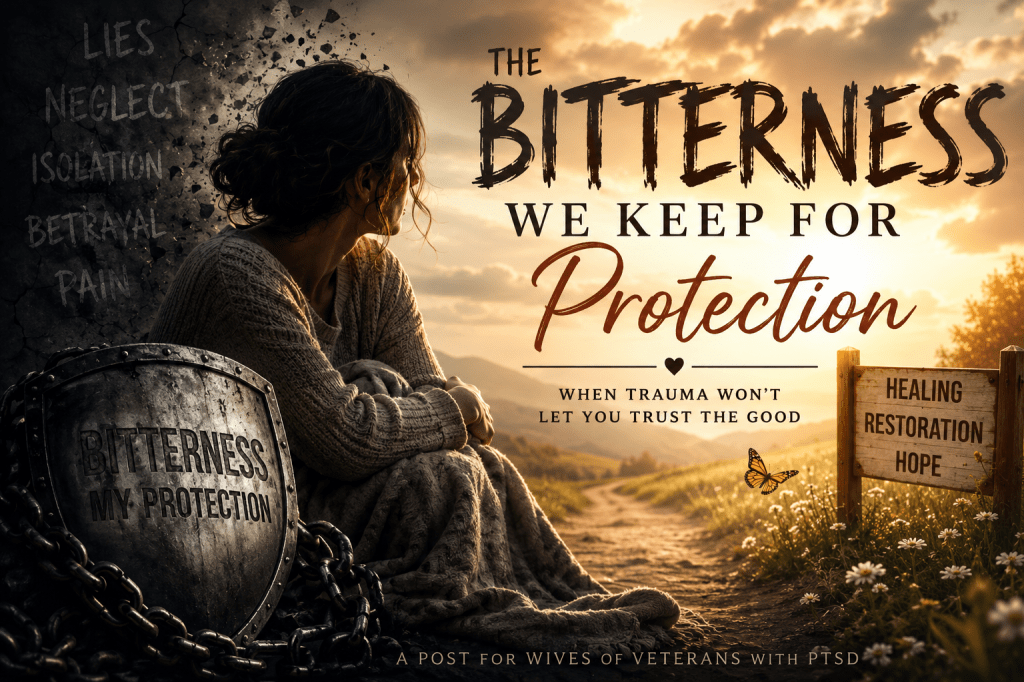
The Bitterness We Keep for Protection

It’s difficult not to carry bitterness after years of lies, isolation, disappointment, and neglect. Even when progress finally begins to happen—when you start to see the changes you’ve prayed for over countless sleepless nights—your trauma-fogged mind doesn’t immediately celebrate. Instead, it whispers, What if this doesn’t last? What if this all falls apart again?

Before long, those whispers become screams. Don’t trust it. Don’t believe it. You’re going to suffer again.

It’s a fight-or-flight response that every wife living alongside PTSD understands. It’s that familiar feeling of being pulled back into the darkness just when you thought you had finally found your footing. You try so hard to climb out of the hole, only to find yourself peering back over the edge, waiting for the ground to give way beneath you again.

The truth is, that kind of bitterness doesn’t simply disappear when happiness or healing begins to emerge. It lingers quietly in the background, like a shadow waiting for the perfect opportunity to remind you why you built walls around your heart in the first place. It waits for one bad day, one harsh word, one familiar pattern, hoping to convince you that nothing has really changed after all.

Because when you’ve lived in survival mode for so long, joy itself can feel unsafe.

At the end of the day, the feelings of happiness, romance, love, being wanted, being needed, and finally being seen can sometimes feel like a mask you’re simply waiting to slip off. You’re bracing yourself for the moment when the only reality you’ve ever truly known comes rushing back. The bitterness you’ve held onto wasn’t always hatred—it was protection. It was armor. It was the emergency plan you kept hidden away because some part of you refused to trust that restoration could actually be real.

Trauma leaves wounds that do not always bleed where others can see them. They remain open beneath the surface, quietly whispering that you’ll never be enough, that you’re not safe, and that hope is dangerous.

But perhaps the greatest act of faith isn’t pretending those wounds don’t exist. Perhaps it’s choosing, one day at a time, to believe that God can heal the places we’ve spent years trying to protect ourselves from feeling.

The Secret Place

Somewhere in the mess… you disappeared.

Between the responsibilities, the heartbreak, the expectations, and the silent battles no one sees—you got lost. Not all at once. But slowly. Quietly. Piece by piece.

And now you look in the mirror and barely recognize her.

Here is the truth no one wants to say out loud:
You will not find yourself in the noise.
You will not heal by staying busy.
You will not rise by pretending you’re fine.

You find yourself in the longing.

That ache deep inside that whispers, There has to be more than this.

We were never called to survive at surface level. Survival keeps you functioning—but it does not make you whole. It keeps you moving—but it does not make you free.

Freedom lives in the secret place.

Not a physical place. A sacred one. The place where only you and the Father have walked. The place you avoid because it feels too deep, too raw, too exposed.

But that is where she is.

The happy, carefree, full-of-life, Jesus-got-this kind of girl. She isn’t gone. She’s buried under fear, disappointment, and exhaustion.

Scripture says,

“He who dwells in the secret place of the Most High shall abide under the shadow of the Almighty.” — Psalm 91:1

Dwelling requires staying.
Staying requires courage.

It takes courage to sit still long enough to feel what you’ve been outrunning.
Courage to face the darkest parts of your own heart.
Courage to stop surviving and start seeking.

But healing does not happen on the surface.

It happens in the depths—the place where the tears fall freely and the masks come off. The place where you finally whisper the prayers you’ve been afraid to pray.

And there, in that quiet, the Father meets you.

Not with shame.
Not with disappointment.
But with presence.

Until you choose to rise and visit the hidden places of your soul, you will never rise from the ashes of the life you are living.

It is okay to feel.
It is okay to stop.
It is okay to take time for you.
To be quiet.
To be still.
To search.
To seek.
To pray.

Push yourself toward what makes you healthy. Safe. Stable. Whole.

Turn down the noise.
Shut the door.
Go to the secret place.

And stay.

Because when you do, the pieces begin to settle. The lies lose their grip. The chaos grows quiet.

And one day you will look in the mirror again—

And recognize her.

Not the woman who barely survived.
But the one who went into the depths…
and came back alive.

Her Silence

Silence isn’t harsh.

It isn’t cold.
It isn’t punishment.
It isn’t manipulation.

It is exhaustion.
It is grief.
It is quiet defeat after fighting battles no one else saw.

When her voice has been dismissed long enough…
When her emotions have been minimized…
When her needs have gone unmet…

Silence does not arrive loudly.

It creeps in.

Slowly.

She does not wake up one morning deciding to withdraw. She arrives there after trying. After explaining. After crying. After praying. After hoping.

And when nothing shifts… something inside of her does.

Silence becomes protection.

Not because she wants distance — but because she can no longer survive exposure.

Survivor mode is never a place she longs to be.

No woman dreams of becoming guarded. No wife desires to grow quiet. No heart hopes to become cautious with the very person it once felt safest with.

And yet, survivor mode often finds her.

It finds her when she realizes she must fight not just for the marriage — but for herself.

There is a particular kind of desperation in silence. It is the moment she realizes that if she does not guard her heart, she may lose herself entirely in the longing for what used to be.

But here is the sacred turning point:

If she finds the strength and courage not to disappear inside the silence… she will discover something unexpected there.

She will find herself.

Not the version shaped by disappointment.
Not the version shrinking to be understood.
Not the version constantly over-explaining her pain.

But a woman rebuilding.

A woman expecting.

Expecting growth in the quiet.
Expecting clarity in the stillness.
Expecting healing in the hidden places.
Expecting peace that does not depend on another person’s consistency.

There is hope in her silence.

Because silence is not the end — it is the reset.

Psalm 46:10 says,
“Be still, and know that I am God.”

Be still.

Not because the pain isn’t real.
Not because the marriage doesn’t matter.
Not because the hurt disappears.

But because in the stillness, God begins to restore what chaos tried to steal.

In the silence, He reminds her:

She is not invisible.
She is not irrational.
She is not too much.
She is not alone.

He meets her there — not in the shouting, not in the proving, not in the defending — but in the quiet surrender.

And slowly, what once felt like defeat becomes rebuilding.

She finds peace in the silence.
Growth in the silence.
Joy in the silence.
Hope in the silence.
Laughter in the silence.
A new breath of life in the silence.

The silence that once felt like loss becomes the place she rediscovers her strength.

And when she rises again, she will not rise hardened.

She will rise healed.

And that kind of woman?
She no longer fights to be heard.

She walks in peace — knowing the One who sees her never stopped listening.

The Dirty Window

Oftentimes I sit at the large kitchen island, directly across from a dirty window.

I sit there with great intention — determined to put my thoughts on paper. But more often than not, I find myself just staring… gazing for what feels like an eternity through that dirty window.

And as I sit here again, staring through the smudged glass, I begin to wonder why I have never mustered up enough motivation to clean it.

In an awkward, almost confusing way, I have come to realize something:

I find comfort in the dirty window.

As strange as that sounds, I’ve caught myself rationalizing it more than once. The dirty window has become a quiet form of consistency. And if I am honest, consistency is something my heart longs for more often than I would like to admit.

The window is imperfect — yet unchanging.
The beautiful view beyond it is clouded by spatter and streaks.
The mess blurs what could otherwise be clear.

And yet… it remains the same.

Then it hits me.

Life is the dirty window.

Each day brings its own spatter. Its own streaks. Its own unexpected splashes of chaos that we often have no idea how to cleanse. The more we try to wipe it away, sometimes the more smeared and cloudy it becomes.

We try to fix the mess.
We try to restore clarity.
We try to regain control.

But life lacks the consistency we crave.

Every new day holds unknown variables.
Unexpected conversations.
Unplanned disappointments.
Unforeseen struggles.

And that lack of consistency can create an environment that feels unsteady. Unstable. Unpredictable.

Yet at the end of the day, when I sit back down at the island and gaze through that same dirty window, there is something oddly comforting about its unchanged imperfection.

The mess is still there.
The smudges haven’t moved.
The view is still blurred.

And somehow, that consistency in the imperfection steadies me.

But here is what the Lord has been gently whispering to my heart:

While the window may remain dirty… He does not.

Our days may feel inconsistent.
Our emotions may fluctuate.
Our circumstances may cloud our vision.

But God is not unstable.

“The Lord is my refuge and my fortress, my God, in whom I trust.” — Psalm 91:2

Refuge.
Fortress.
Not shifting.
Not unpredictable.
Not clouded.

When life spatters our windows and blurs our view, it is easy to grow accustomed to the mess. We learn to live with the streaks. We adapt to the distortion. Sometimes we even mistake the familiar chaos for comfort.

But our true consistency is not found in the unchanging mess.

It is found in an unchanging God.

Hebrews 13:8 reminds us:

“Jesus Christ is the same yesterday and today and forever.”

Yesterday — when the window first got dirty.
Today — as we stare through it.
Forever — long after the smudges are gone.

Life may feel inconsistent.
Our emotions may feel unstable.
Our clarity may feel clouded.

But God remains steady in the middle of our scattered days.

And maybe — just maybe — the dirty window isn’t there to comfort me.

Maybe it is there to remind me that even when my view is blurred, my foundation is not.

Even in the mess.
Even in the unknown.
Even in the inconsistent chaos of each day.

He is steady.

And that is enough.